
An airport art installation is the hardest kind to place, and the reason is simple: nobody came for it. Every person in the building is in transit, has a gate to reach, and will give the piece a few seconds at most.
That changes every design decision. A piece that would stop traffic in a mall is a hazard in a terminal. A piece that holds attention in a shop window has no audience. And a piece that reads beautifully in a render can disappear once it is competing with wayfinding, screens and a moving crowd.
The rule is the one that applies to any commercial installation — the site decides — but in an airport the site is more restrictive than anywhere else.
What airports actually commission
Four types, and they are judged differently.
Seasonal and ceremonial — Deepavali, Lunar New Year, Christmas, a national day. These run for weeks, sit in the public areas, and carry a cultural message the airport has chosen to send. They also have to come down cleanly.
Gateway pieces — at a kerb, a departure hall or a transit node. These are the pieces a traveller photographs, and they are judged on whether they say “this airport” at a glance.
Retail-adjacent displays — in the commercial zones. These follow retail rules rather than art rules: they exist to slow people down near the shops.
Wayfinding-integrated work — the rarest and the hardest, where the piece also helps people navigate.
Each type is a different brief, and mixing them is how projects go wrong: a ceremonial piece built like a gateway piece will block the concourse it was meant to decorate.
Designing for a moving viewer
The biggest difference from any other venue is that the viewer is walking. In an airport art installation, nobody stands still to look.
Sizing follows from that. A piece read from 15 to 30 metres at walking pace needs a strong silhouette and large colour blocks; fine detail is wasted because nobody comes close enough to see it. Depth matters less than mass — a shallow, wide piece usually reads better in a concourse than a tall, detailed one.
The other rule is that the piece must not work too well. Anything that makes people stop dead in a transit corridor is a problem: it blocks the flow the airport is measured on. The target is a piece that registers, slows a step, and does not arrest.
Where an airport art installation can go — and where it cannot
Five positions account for most airport work, and each has its own limit.
1. Kerbside — high visibility, short dwell, weather exposure. Sizes go large.
2. Departure hall — the highest traffic and the tightest rules. Nothing on the floor.
3. Transit concourse — long sightlines, moving crowd. Silhouette over detail.
4. Gate hold rooms — a seated audience and longer dwell, so small scale works here.
5. Planting beds and landscaped areas — the most forgiving position, because a piece set into planting does not read as an obstacle.
That last one matters more than it looks. A piece among real plants sits outside the walking line, so it does not compete with the flow, and the planting quietly solves the “where does it stand” problem.
Four constraints run through all five positions: evacuation routes, the wayfinding hierarchy, camera sightlines, and access for cleaning. None are negotiable, and all are cheaper to accommodate at design stage than after approval.

The Changi peacocks — a worked example
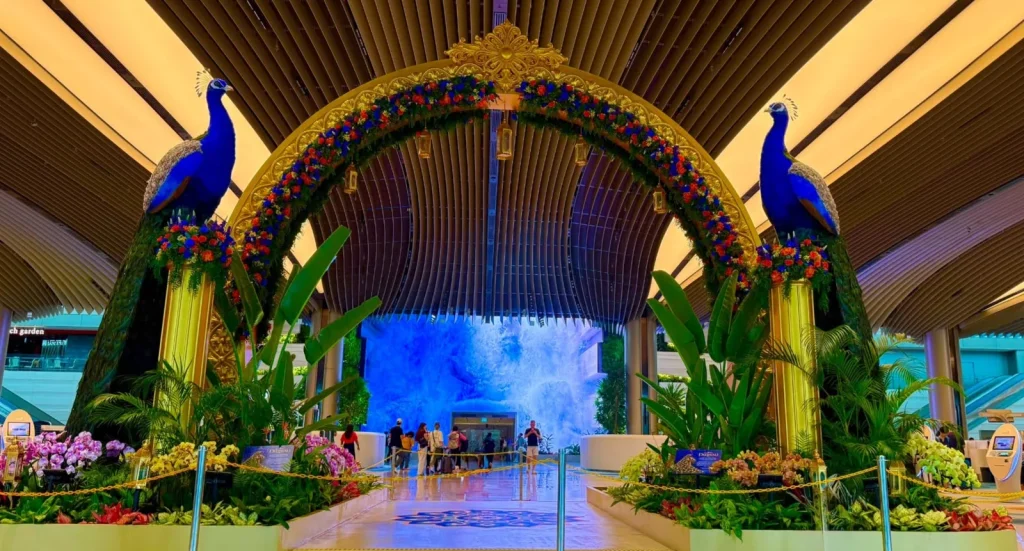
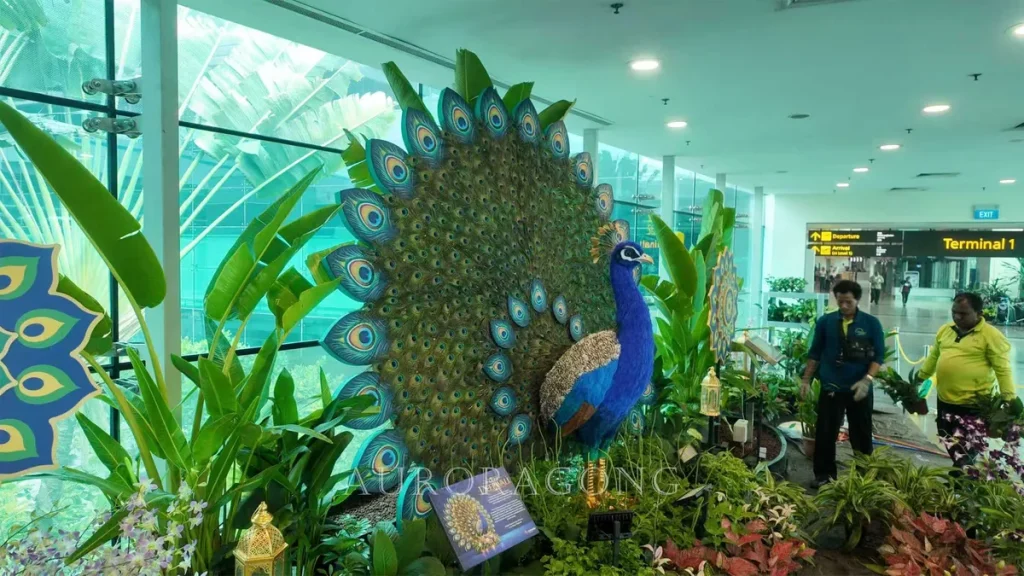
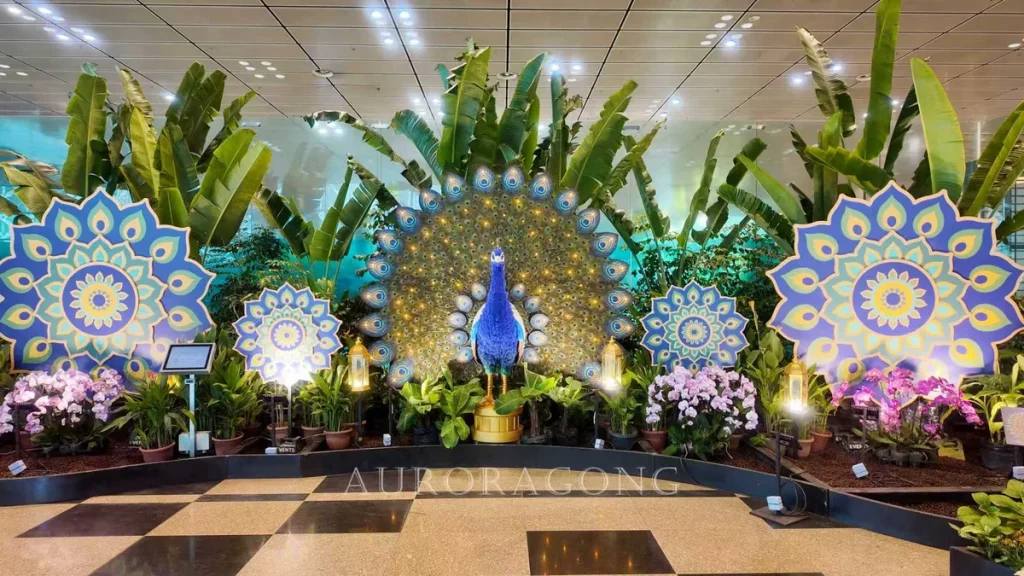
At Changi Airport, four peacocks stand 4.5 metres high, each carrying more than 2,000 real peacock feathers planted one by one. The commission was for Deepavali, the festival of lights, and the bird was chosen because it carries meaning in both Chinese and Indian culture — which is the point at an airport that serves both.
Two decisions made the project work.
The first was setting the birds into the planting rather than on plinths. In a terminal a plinth reads as an obstacle; a piece among plants reads as part of the landscape. The birds stand in the floral displays of each area, which removes the floor-clutter problem entirely.
The second was scale discipline. At 4.5 metres the birds read from across the concourse, while their detail — the feathers, the head, the posture — is carried at eye height where people actually pass. Neither the mass nor the detail is wasted.
The full case is on our peacock art installation at Changi Airport page.
Six things the brief has to answer
1. Which position, and the main viewing distance and direction.
2. Which audience — transiting passengers, departing passengers, or meeters and greeters. Their dwell times differ.
3. When it must be up and down, and whether the occasion recurs annually.
4. What it must not block: evacuation routes, wayfinding, cameras, retail sightlines.
5. What it can be fixed to, and whether the building permits it.
6. Whether the piece will be re-used, and where.
Item four sends more designs back than any other. A piece can be beautiful and still fail approval because it stands where a fire door needs to open.
Frequently asked questions
What is the difference between airport art and public art?
The audience is similar; the constraints are not. A public square can stop people and hold them. An airport cannot — flow is the primary function, and the piece has to sit inside it rather than interrupt it.
How big should an airport art installation be?
Big enough to read from 15 to 30 metres at walking pace, which usually means a strong silhouette rather than fine detail. At Changi the peacocks stand at 4.5 metres.
How long does an airport commission take?
Typically three to five months from brief to installation — longer than a mall project, because approvals take longer and access windows are often at night.
Can an installation block a walkway?
No. Evacuation routes and cleaning access have to stay clear, and that is usually where a design gets sent back. Work from the site plan at the first sketch.
Are airport installations seasonal or permanent?
Both exist. Ceremonial pieces run for weeks; gateway pieces are built to stay. They are different briefs and different builds.
What should a brief contain?
The position and its viewing distance, the dates, the audience, what cannot be blocked, and the fixing points available. That is enough to come back with a size and a layout.
If you have a terminal position and a date, the next step for an airport art installation is the site survey rather than a concept — see how that runs across our commercial art installations, and how the scale discipline shows up in a light sculpture.