
Peacocks in Full Display at Changi: Chinese and Indian Symbols Meet at Deepavali
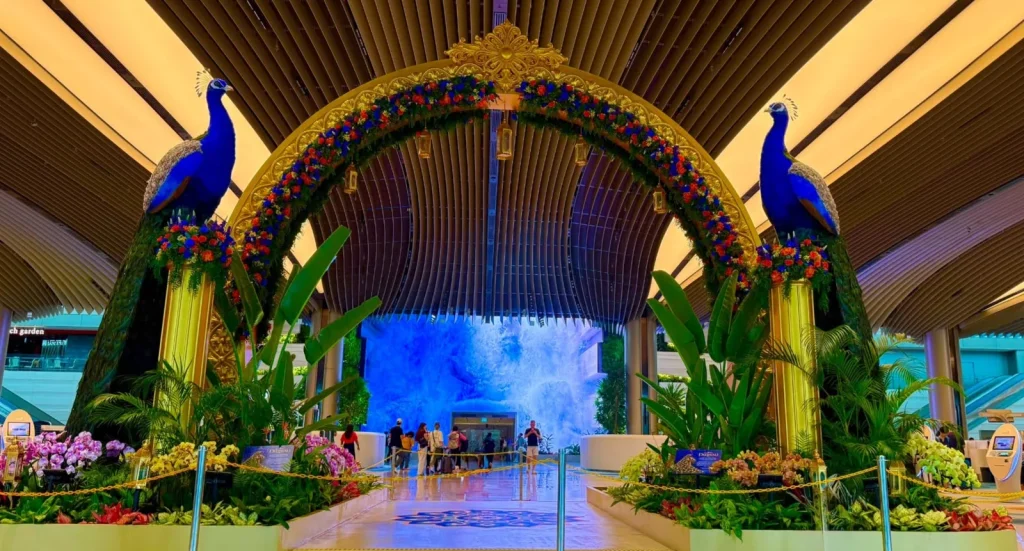
Changi Airport is marking Deepavali, the Festival of Lights — one of the most colourful festivals of its year. This year, a peacock art installation made by AuroraGong has gone up across several of the airport’s terminals, using sculpture, floral arches and feather walls to bring South Asian festival colour into a route every traveller walks through.
One bird, three readings
The peacock is the set’s core visual symbol. In the Hindu tradition, the peacock is the mount of Murugan, the god of war, and stands for victory, love and wisdom; the peacock feather itself is held to ward off harm and bring prosperity to a household. In Peranakan Chinese culture in Singapore the bird carries similar weight — a peacock was the badge of a third-rank civil official under the Ming and Qing dynasties, a mark of rank, and at weddings it is often paired with the phoenix to stand for the union of yin and yang. The same bird, read across communities, carries a closely related idea of good fortune. The same bird means much the same thing to both communities — part of how Singapore’s cultures sit side by side.
Flowers, sculpture and kolam
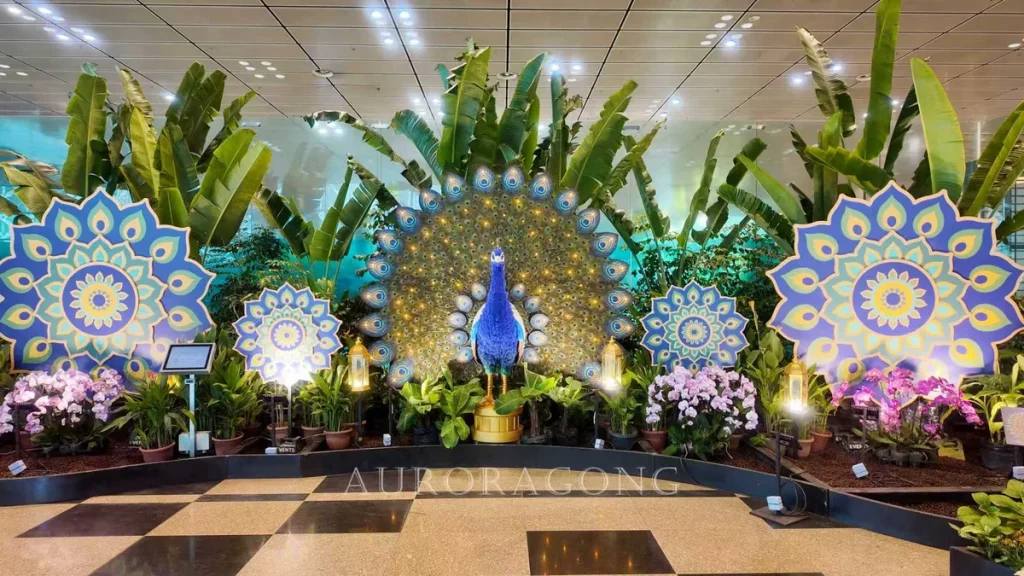
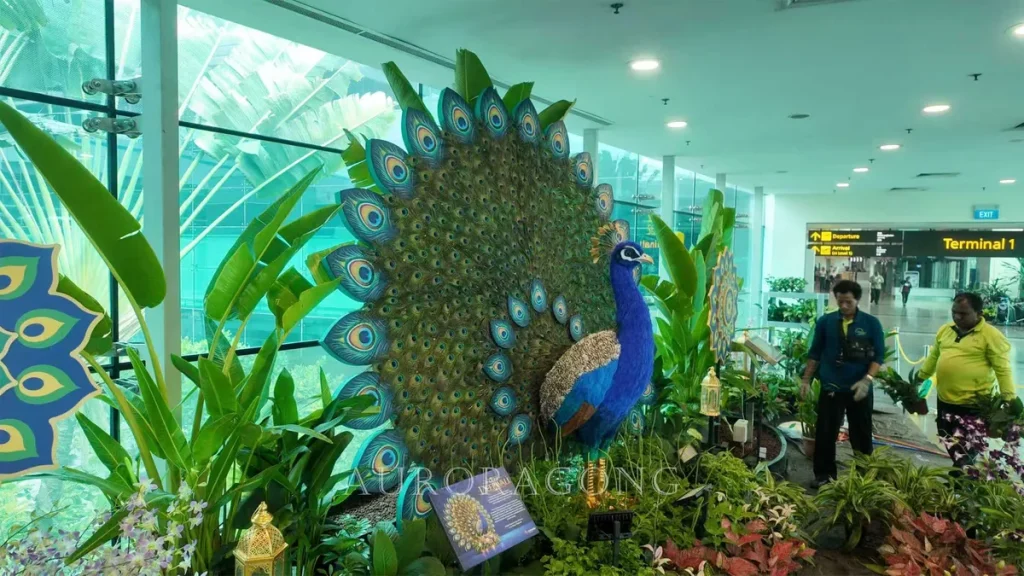
The peacock art installation is built from several units: peacock sculptures, floral arches and a peacock feather wall, worked together with tropical orchids, banana leaves and mandalas in blue, yellow and purple — the colours of kolam, the traditional Indian floor drawing. Kolam uses painted geometric patterns to invite deities into the home, and is a familiar sight at doorways during Deepavali. The “thousand eyes” pattern on a peacock’s tail is also read, in Peranakan contexts, as a guard against the evil eye. None of these elements were copied as they were. They were rebuilt in a contemporary form: the full festival scene works from a distance, and the way the feathers and flowers were handled shows up close.
Craft: 4.5 metres high, 2,000 feathers deep
There are four peacocks in the set, each an enlarged blue peacock standing 4.5 metres tall. The size is handled with the traditional Zigong lantern-making method: a three-dimensional frame is built first to set the shape, then covered layer by layer, so a 4.5-metre body still holds together as one full, rounded form from a distance rather than collapsing or flattening.
Key facts — 4.5 m tall · 4 pieces · more than 2,000 peacock feathers per bird · all feathers real peacock feathers
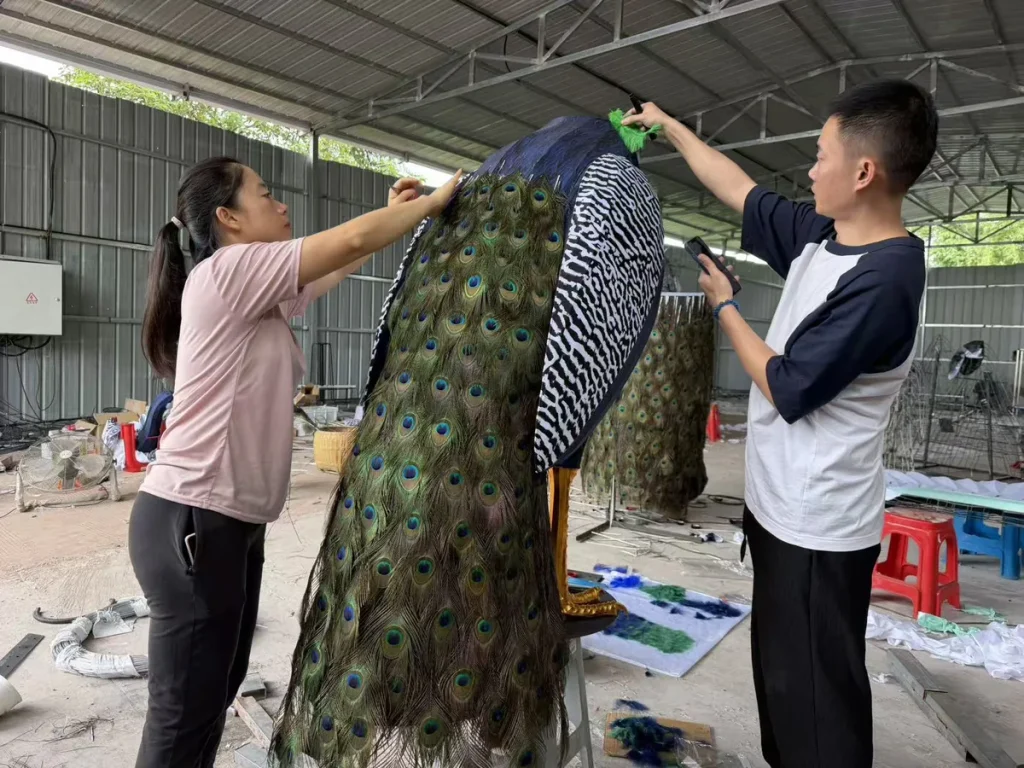
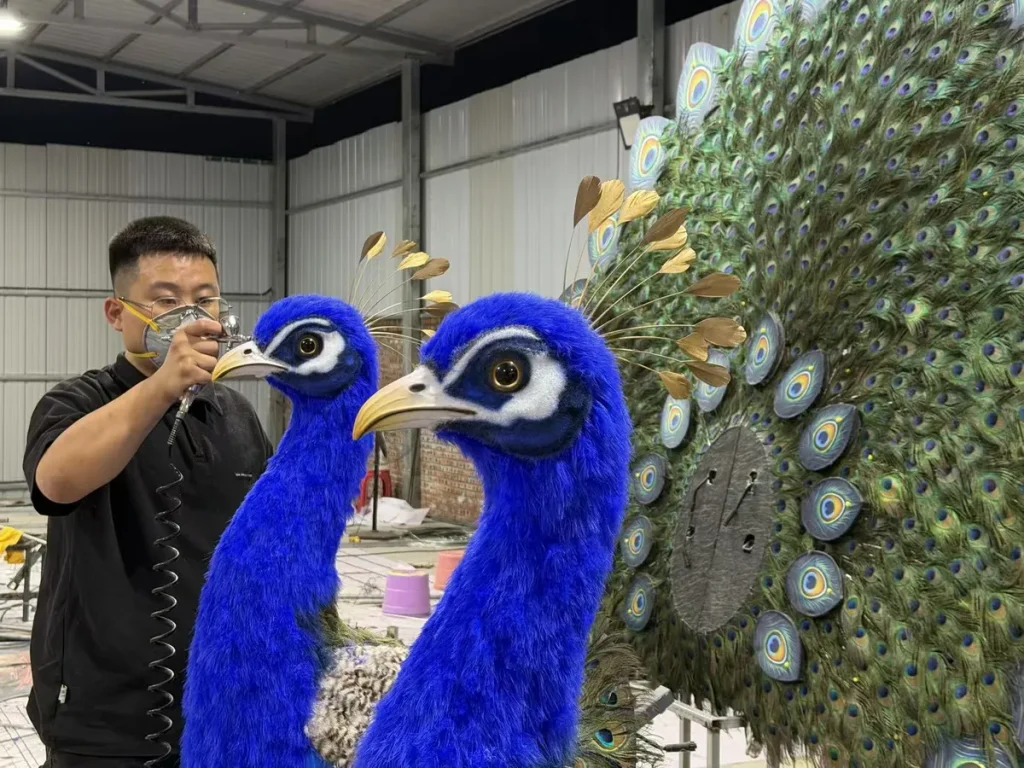
The realism comes from a feather-planting process. Each bird takes more than 2,000 real peacock feathers, planted one by one into the surface. From a distance it reads as a loose field of blue-green; close up, the direction, the sheen and the layering of each feather are visible.
The peacock art installation was not set up as a group of stand-alone exhibits. They were set among the real plants and floral work of each display area — peacocks standing in planting, tails spread, tied into the floral arches and lighting around them to form one garden scene.
From India to the world
The peacock art installation was made by AuroraGong and designed for Changi Airport. As one of the world’s major aviation hubs, the airport handles tens of millions of travellers a year, and the work puts South Asian festival culture in front of transit passengers within a few minutes’ walk. As the Peranakan Museum’s “Peacock Power” exhibition put it, the peacock is a symbol that crosses communities, religions and borders.
Deepavali marks light overcoming darkness and good overcoming evil. The installation stays on display until early November.
About AuroraGong
AuroraGong is based in Zigong, Sichuan, China, and specialises in custom lanterns, animatronic animals and large-scale art installations, handling projects from design and production through to on-site placement. The company has worked in more than 40 countries.