
Purchasing an order for a customized 1:1 F1 display car is not only about acquiring a product but also a project that requires consideration of many elements, such as design, material choice, and installation logistics. For those clients wishing to contact an F1 display car manufacturer, those who are able to define their requirements from the onset will enjoy the benefits of reduced lead time and costs associated with revisions.

This article will address some of the main considerations before ordering.
Clarify Your Use Case First
Before we can start thinking about specifications, the first step to take is determining how the display car is going to be used. This determines the design’s structure, material, and finish, among other things.
Typical use cases include:
- Indoor showroom or brand display
- Automotive exhibition or motorsport event
- Shopping mall or commercial activation
- Photo/video production setup
- Permanent installation or touring display
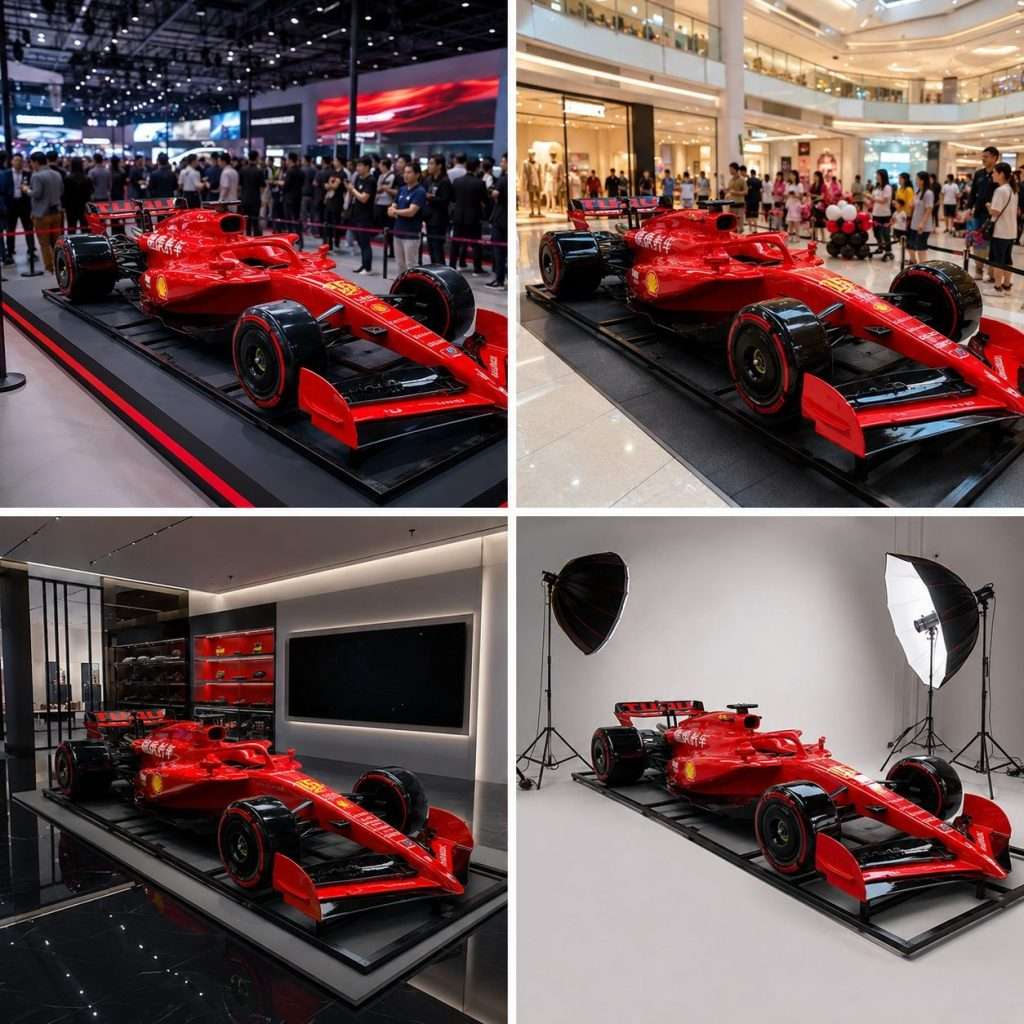
All these applications have their own requirements in terms of durability, modularity, surface treatment, etc. For instance, the display for tours should feature a modular design and additional reinforcement by means of an internal steel framework, while a stationary display should focus on a high-quality surface finish.
Not specifying usage scenarios in the very beginning is one of the primary mistakes leading to redesigning in the middle of production.
Decide Your Target Detail Level (Not All Builds Are Equal)
In case of ordering a 1:1 F1 display car replica, most consumers expect that all other car models will be built in the same way.
Key decision points include:
- Level of geometry accuracy (exact race-spec vs simplified visual replica)
- Aerodynamic component fidelity (functional replication vs decorative shaping)
- Surface detail depth (rivet, carbon texture, mechanical exposure)
- Branding customization (team livery, sponsor integration, custom design)
A clear specification at this stage helps the manufacturer determine whether your project requires full engineering replication or exhibition-grade interpretation.
Material Strategy Should Match Environment
Material selection is not about “quality vs low quality”—it is about matching structure to usage environment.
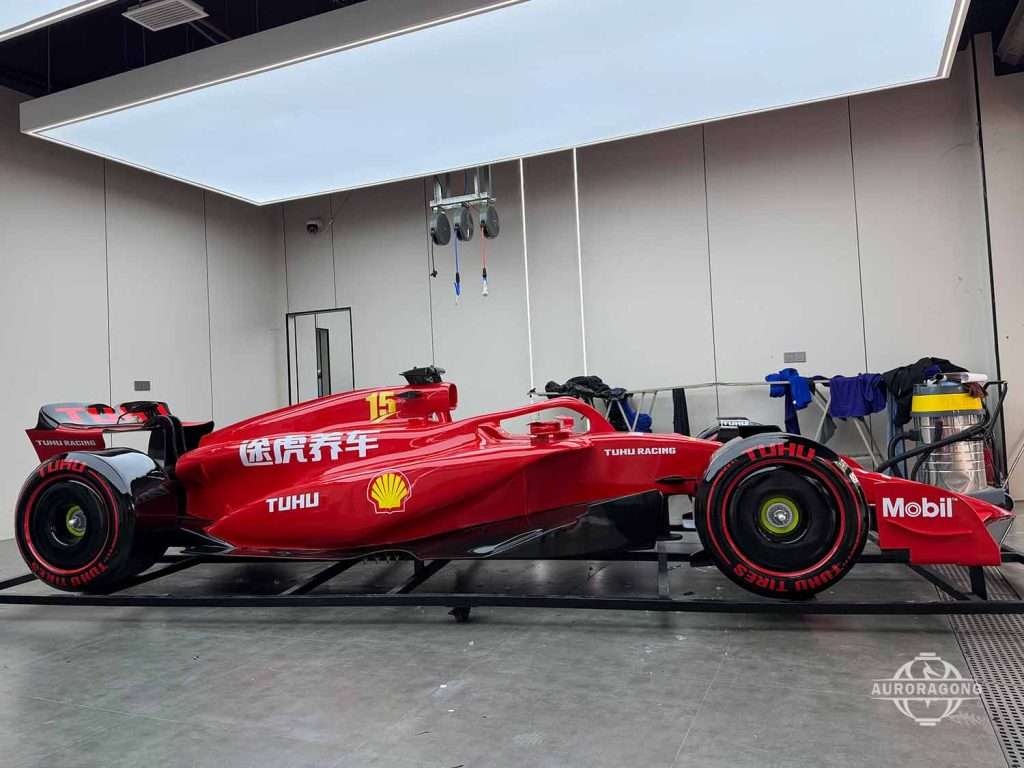
For most fiberglass F1 display car projects, material systems are typically combined:
- High-strength steel for internal load-bearing structure
- Fiberglass for large aerodynamic body panels
- Epoxy resin for shaping and bonding stability
- Photosensitive resin for fine-detail components
- Atomic ash for surface leveling and correction
- Automotive paint for final visual finishing
If your display car will be transported frequently or used in public spaces, structural reinforcement becomes more important than ultra-fine surface detail. If it is a fixed installation, finishing precision becomes the priority.
Understand the Full Production Workflow Before You Order
A reliable supplier should be able to clearly explain how your project moves from concept to installation. A typical production flow includes:
- Design – translating reference and requirements into a build plan
- 3D Modeling – confirming proportions and structure digitally
- 3D Printing – validating key components and fine details
- Model Assembly – constructing a full-scale structure and body
- Puttying and Sanding – refining surface smoothness and alignment
- Color – applying automotive-grade paint and livery
- Packaging and Shipping – modular breakdown for safe transport
- Installation – on-site assembly and final adjustment

If a manufacturer cannot clearly map your project to these stages, it usually indicates limited control over production quality.
Packaging and Transport Should Be Planned Early
One of the most overlooked aspects of a custom F1 display car project is logistics. Due to its full-scale size, the model is usually shipped in modular sections.
Buyers should confirm:
- Whether the structure is designed for disassembly
- How modules are reinforced for shipping
- Whether on-site installation support is available
- What tools or infrastructure are required at the destination
Omitting this procedure usually results in extra expenditures or delays when assembling the ordered cars.
What You Should Prepare Before Contacting a Manufacturer?
To speed up quotation and reduce revisions, prepare the following information in advance:
- Reference F1 model or era (or custom design direction)
- Intended usage scenario and installation location
- Expected detail level (standard/high/exhibition-grade)
- Branding or livery requirements
- Budget range and delivery timeline
- Installation conditions (indoor, outdoor, fixed, mobile)
Clear input at this stage allows the manufacturer to propose a more accurate technical solution instead of a generic quote.
How to Evaluate a Suitable F1 Display Car Manufacturer?
When comparing suppliers, avoid focusing only on visual renders or initial pricing. Instead, evaluate capability through execution evidence:
- Real production cases (not only design renders)
- Control over full workflow from design to installation
- Ability to manage fiberglass structural fabrication
- Experience with large-scale packaging and export logistics
- Consistency in finishing quality across previous projects
In practice, the difference between suppliers is often revealed during surface finishing and structural alignment, not during early design stages.
Final Note
It is recommended that one treat a 1:1 F1 display car customized to his taste as an engineering project instead of just buying any product to suit him. The more specific you are in detailing your requirements when ordering, the better the production process becomes.
Designers like AuroraGong, who combine design, modeling, construction, and installation into one flow process, may be chosen due to their ability to ensure high consistency in their work. But the most vital thing is matching your needs with what the manufacturers can produce.