
In the world of collectible and display-grade motorsport replicas, not all scale F1 racing car mold systems are created equal. While many consumers simply distinguish between “toy-grade” and “premium model cars,” professionals in industrial modeling, prototyping, and collectible manufacturing understand that the real differentiation lies in mold engineering and material architecture.
At the center of this distinction are two dominant approaches:
- Fiberglass-based scale F1 racing car mold systems
- Conventional plastic or standard mold systems (ABS/PVC injection or low-grade resin tooling)
Understanding What a Scale F1 Racing Car Mold Actually Does
A scale F1 racing car mold is not simply a shaping tool—it is a precision replication system that determines:
- Aerodynamic surface fidelity
- Dimensional scaling accuracy (commonly 1:18 / 1:24 / 1:43)
- Panel line sharpness
- Micro-detail reproduction (vents, winglets, suspension geometry)
The quality of the mold directly defines whether a model is perceived as a “toy replica” or a “collector-grade engineering miniature.”
Fiberglass Mold System: Layered Composite Engineering
A fiberglass F1 racing car mold is typically constructed using multi-layer composite reinforcement technology. Instead of relying on rigid metal injection tooling alone, fiberglass molds use:
- Glass fiber reinforcement layers
- Resin matrix binding systems (polyester or epoxy-based)
- Hand-laminated or vacuum-assisted curing processes
Key Engineering Characteristics:
1. High thermal and dimensional stability
Fiberglass composite molds exhibit lower thermal deformation compared to low-cost plastic tooling, allowing stable replication of fine aerodynamic geometry.
2. Superior surface fidelity retention
Because fiberglass molds can capture micro-textures from master prototypes, they preserve carbon fiber simulation patterns and aerodynamic edge transitions more accurately.
3. Flexible tooling adaptation
Unlike steel injection molds that require expensive re-machining, fiberglass molds allow iterative modification during prototyping stages.
This makes them particularly suitable for limited-edition F1 scale models and collector-grade replicas.
Standard Scale F1 Racing Car Mold: Injection-Based Production Logic
In contrast, conventional scale F1 racing car mold systems used in toy manufacturing rely on:
- Steel injection molds
- ABS or PVC thermoplastic injection
- High-pressure, high-volume production cycles
Engineering Limitations:
1. Geometry simplification
Injection molding requires draft angles and wall thickness constraints, which force simplification of aerodynamic details.
2. Surface softening effect
Molten plastic flow reduces the sharpness of micro-details, especially in wing edges and suspension structures.
3. Mass-production bias
These molds are optimized for cycle time and durability—not precision.
As a result, standard molded F1 models often lose the “mechanical tension” present in real Formula 1 geometry.
Detail Reproduction: Where Fiberglass Clearly Wins
One of the most critical differentiators is micro-detail retention capability.
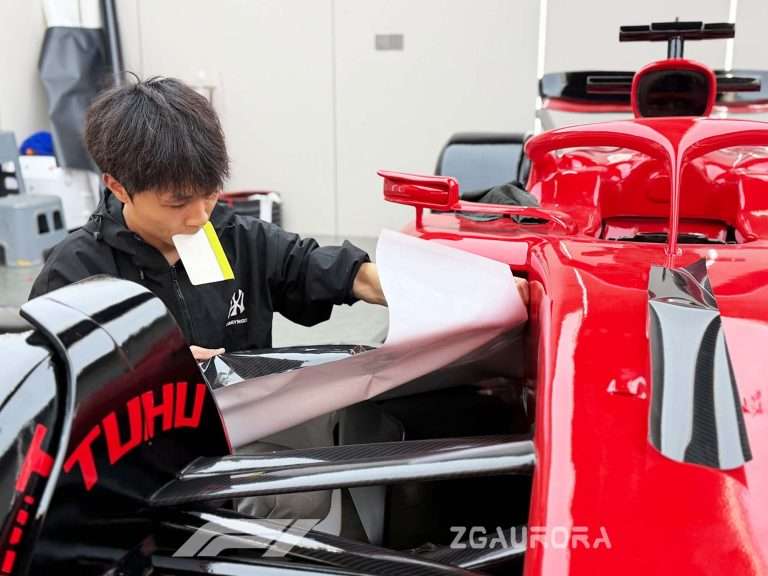
Fiberglass Mold Systems Enable
- Sharper front wing cascade elements
- Accurate halo structure geometry
- Fine brake duct openings
- Realistic air channel separations
- Precise surface curvature transitions
Standard Injection Molds Produce
- Rounded edges instead of sharp aerodynamic cuts
- Simplified internal airflow structures
- Reduced panel line depth
- Limited replication of underbody complexity
This difference is not cosmetic—it directly affects perceived realism under lighting conditions, especially in display environments.
Surface Finishing and Paint Adhesion Behavior
Another often overlooked engineering difference is how each mold type interacts with surface finishing.
Fiberglass Mold Output
- Higher surface energy compatibility with primer layers
- Better adhesion for multi-layer automotive paint systems
- Supports gloss, matte, and carbon-fiber texture simulation
- Reduced orange-peel effect after coating
Standard Plastic Mold Output
- Requires additional surface treatment (plasma or sanding)
- Higher risk of paint inconsistency
- Limited fidelity in metallic or matte finishes
For premium collectors, surface finishing is often more important than structural durability.
Structural Integrity vs Precision Trade-Off
These two mold systems optimize for completely different engineering goals:
| Feature | Fiberglass Scale F1 Mold | Standard Plastic Mold |
| Detail Precision | Very High | Medium |
| Mass Production Efficiency | Low | Very High |
| Tooling Cost | Medium-High | Low per unit |
| Durability | Moderate | High |
| Collector Value | High | Low |
Fiberglass systems intentionally sacrifice industrial throughput in favor of precision geometry preservation.
Why Fiberglass Mold Systems Are Preferred in Premium F1 Models?
In high-end collectible manufacturing, realism is not just visual—it is structural fidelity to aerodynamic intent.
Fiberglass scale F1 racing car mold systems are preferred because they:
- Preserve the engineering complexity of real F1 vehicles
- Allow short-run customization and limited editions
- Enable prototype-level accuracy without full steel tooling investment
- Support artisan-level finishing processes
This makes them ideal for brands targeting premium collectors, motorsport enthusiasts, and exhibition-grade model displays.
AuroraGong Fiberglass Scale F1 Racing Car Model Advantage
At AuroraGong, our fiberglass mold-based F1 scale model system is designed specifically for high-fidelity automotive replication, focusing on:
- Precision fiberglass composite mold fabrication
- Multi-layer curing for structural stability
- High-definition aerodynamic surface reproduction
- Collector-grade finishing standards
Compared to conventional scale model production, our approach prioritizes engineering realism over mass-market simplification, making each model closer to a scaled-down motorsport artifact rather than a toy replica.
Conclusion

The difference between a fiberglass scale F1 racing car mold and a standard mold system is not merely material-based—it is a difference in manufacturing philosophy.
- Fiberglass molds represent precision-driven, low-volume engineering
- Standard injection molds represent cost-efficient, high-volume production
For collectors and professional-grade model applications, fiberglass systems deliver a fundamentally higher level of realism, detail retention, and surface authenticity.
In short, if standard molds create “toy interpretations” of F1 cars, fiberglass molds create scaled engineering replicas that preserve the spirit of Formula 1 design.