
Silk flower lanterns have become one of the most flexible tools in a commercial decorator’s kit — bright enough to carry a shopfront window after dark, detailed enough to stand one metre from a shopper’s phone camera. This guide covers what they are, where they work best, how they are sized and fixed, and what a realistic project timeline looks like for malls, hotels, botanical gardens and city streets.


What Are Silk Flower Lanterns?
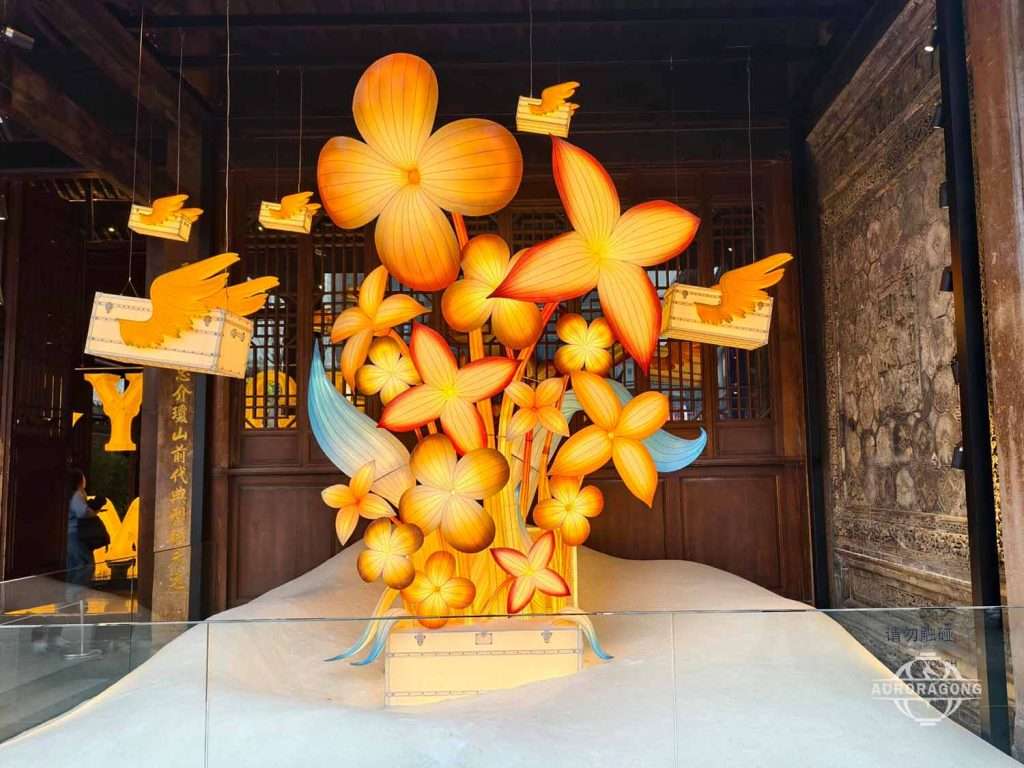
A silk flower lantern is a decorative light sculpture built in the shape of a bloom — peony, lotus, cherry blossom, magnolia, rose, or a completely invented flower — with petals finished in stretched silk and lit from inside by LED modules. Unlike a paper lantern, the silk surface diffuses light evenly, so petals glow rather than shine. That soft edge is the reason the effect photographs well, and photography is now the main way a display earns its budget.
Silk has been used for lantern making for centuries, and the technique still matters commercially: see Wikipedia: Silk for the background.
Buyers usually meet the category under three names. In sourcing enquiries it is often called a silk lantern; European and Middle Eastern specifications frequently list the same item as lantern silk; and in retail fit-out briefs it appears simply as a decorative floral light feature. All three describe the same product family, and a workshop that builds one normally builds the others.
Window Display Decorative Lanterns
Window display decorative lanterns solve a specific retail problem. A shopfront window has to read from the street after closing, when the interior is dark and the glass starts behaving like a mirror. A hanging cluster of blossoms placed in the upper third of the window catches the eye from thirty metres away and gives the display a depth that flat signage cannot produce.
The same logic scales up in shopping centres, where silk flower lanterns hang from atrium rails, escalator voids and entrance canopies. A centre can run one floral theme across dozens of units without repeating a fixture. Teams planning a centre-wide scheme usually start from a shopping mall decorative lanterns plan, then select flower forms to match the season and the tenant mix.
Three practical notes for window work:
- Keep the brightest elements above eye level, so glass does not reflect them straight back at the viewer
- Use warm white for luxury and fashion tenants, saturated colour for family and entertainment zones
- Leave a service gap of roughly 400 mm behind a window piece, so lamps can be reached without dismantling the display
Outdoor Decorative Lanterns for Plazas, Streets and Gardens
Outdoor decorative lanterns face a different set of demands: wind load, rain, public access, and in most cities a fixed installation window. Ground-mounted flower pieces are engineered with a concealed base that can be bolted to a slab or ballasted where drilling is not permitted, and cable runs leave the fixture below ground level.
Three formats dominate outdoor briefs:
- Walk-through pieces — an arch or tunnel visitors pass beneath, such as a flower arch lantern or a full floral lantern tunnel. These produce the highest photo volume per square metre of any format.
- Hero pieces — a single oversized bloom, often a large floral decorative lantern or an illuminated peony lantern, placed at a decision point in the visitor route.
- Field planting — dozens of smaller blooms spread across a lawn or along a path, as in an outdoor glowing flower lantern scheme. This fills distance cheaply and reads well from a distance.
A walk-through element is worth the budget whenever footfall is the goal. Visitors stop, turn around and photograph, and that behaviour is what turns a display into a shared image — the cheapest reach a venue can buy.
Sizing and Fixing
Silk flower lanterns range from 0.6 m tabletop pieces to 6 m landmark blooms; beyond that, the form is usually split into petals that bolt together on site. As a planning rule:
- Window and counter pieces: 0.6–1.5 m
- Atrium and mall hanging clusters: 1.5–3 m
- Plaza and garden ground pieces: 2–4 m
- Landmark hero pieces: 4–6 m and above
Height drives three things in turn: the frame specification, the number of suspension or fixing points, and the shipping method. Anything above roughly 2.3 m in a single dimension travels as assembled sections rather than as a finished piece, so access and lifting need to be confirmed at design stage, not at delivery.
Materials and certification are worth confirming before sign-off. Petal fabric should be flame retardant, and LED and electrical components should carry the certification the venue’s insurer expects — UL or CE depending on the market. Ask for certificate numbers at quotation stage rather than at handover.
One Frame, Four Campaigns
A set of silk flower lanterns goes further when the structure is reusable. The common approach is to specify a neutral frame — stem and foliage that reads as greenery in any season — and swap the flower heads and colour programming between campaigns:
- Spring — cherry blossom and magnolia heads, soft pink and white
- Summer — lotus and water-garden forms, cool blue and green
- Autumn — chrysanthemum and maple forms, amber and deep red
- Winter — poinsettia and frosted white forms, warm white with slow colour shifts
Swapping heads on an existing frame costs a fraction of a new build and can usually be handled by venue staff, which turns a one-season purchase into a multi-year asset. Ask for a spare-head package when ordering.
Planning a Silk Flower Lantern Project
- Brief — send the installation location, ceiling or ground conditions, available power, and reference images.
- Design — drawings and a lighting plan, revised until form and colour are right.
- Production — allow several weeks for a mixed order of window and outdoor pieces; bespoke landmark builds take longer.
- Shipping — packed in sections, by sea or air depending on the opening date.
- Installation — factory technicians or a supervised local crew, depending on venue rules.
For Christmas and New Year campaigns, design needs to be confirmed well ahead of the season: production slots, shipping and installation crews all tighten as December approaches.
Frequently Asked Questions
Are silk flower lanterns suitable for outdoor use?
Yes. Outdoor pieces are built as weather-resistant units with sealed cable entries and a base designed for wind exposure, and they are specified for year-round installation in plazas, gardens and streets. Indoor window and atrium pieces use lighter fixing where weather protection is not required.
Can the colours match a brand or an existing campaign?
Yes. Petal colour, fabric finish, size and lighting program are all adjustable, so a set can be matched to brand guidelines or to a seasonal theme already running in store. Send Pantone references or photographs and the design team will work to them.
How are they powered and controlled?
Every silk flower lantern runs on standard low-voltage LED with a driver sized to the piece. Colour and dimming can run on a simple controller, on a scheduled program, or be tied into a venue’s existing lighting system. Control options are confirmed at design stage so the electrical drawing matches what the site can supply.
Is there a minimum order?
A single hero piece can be commissioned for a storefront window, so there is no fixed minimum for custom work. Most venue briefs, however, combine several sizes — one hero, a few mid-size pieces and a run of small blooms — because mixed sets fill a space more convincingly than one large object.
What maintenance does a display need between seasons?
A silk flower lantern display needs little work between seasons: plan a visual check of fixings and cable entries at each changeover, and keep a small stock of spare modules so a single failure does not darken a hero piece. Seasonal head swaps are designed to be done in place, without lifting equipment.
Start a Silk Flower Lantern Project
Silk flower lanterns work as well in a 1.2 m shopfront window as they do across a 4 m plaza installation — the brief is what changes, not the product. Whether you need one hero silk lantern or a full street scheme, send the window or site dimensions, power availability and reference images through the contact page to receive drawings and a design proposal.