
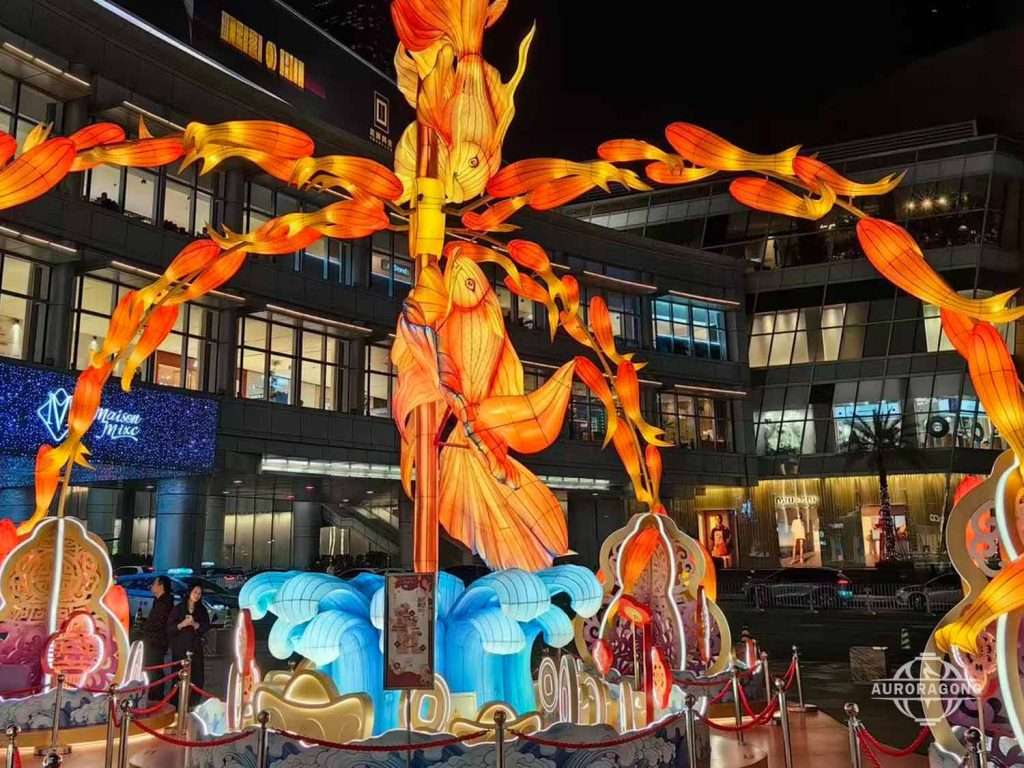
Nowadays, more brands are applying cultural and craftsmanship characteristics in designing offline experiences for their brand products or services. In particular, Zigong lantern art, characterized by scalability, various materials and spatial narrative ability, is one of such highly adaptive visual systems being incorporated into the branding projects.
However, a successful integration is never just an application of styles. A major challenge is how to properly incorporate Zigong lanterns into the brand experience systemically.
Then what would a well-designed brand event involving Zigong lantern art look like? It would definitely not be just an interior decorating plan. Instead, it is a comprehensive spatial narrative system established through five steps of design processes.
No.1: Define the Brand Narrative
The foundation of any successful Zigong lantern-based brand event is not visual design, but narrative definition.
Before any spatial or lighting decisions are made, the brand must clearly establish:
- What is the core story of the event?
- What emotional journey should the audience experience?
- What message should remain after the experience ends?
- What brand values must be translated into physical space?
This step defines the entire structural logic of the experience.
In professional experiential design practice, lantern installations are not starting points. They are output tools of a predefined narrative system.
A common failure in real-world projects is reversing this logic—starting with lantern aesthetics and forcing a story afterward. This leads to fragmented experiences without emotional coherence.
When narrative is correctly defined, Zigong lantern art becomes a controlled storytelling medium capable of expressing specific emotional beats across space and time.
No.2: Experience Map Drawing
Once the narrative is defined, the next step is to translate it into a spatial journey.
This process is known as experience mapping, where the event is structured as a sequence of emotional and physical transitions.
A typical mapping structure includes:
Entry Phase (First Impression)
- High-impact lantern installation
- Immediate brand recognition element
- Emotional “hook” within first seconds
Transition Phase (Immersion Build-up)
- Gradual increase in visual density
- Controlled lighting rhythm changes
- Progressive narrative unfolding
Core Experience Phase (Emotional Peak)
- Fully immersive lantern environment
- Multi-layer spatial composition
- Deep narrative engagement
Exit & Memory Phase
- Photo-oriented composition zones
- Subtle brand reinforcement elements
- Designed emotional closure
This mapping ensures that visitor movement is not random, but guided by a pre-designed emotional trajectory.
In high-end implementations, Zigong lantern is used as a tool to control attention flow, dwell time, and emotional pacing within physical space.
No.3: Visual System Design
After spatial logic is defined, the visual system is constructed as a translation of both brand identity and narrative structure.
At this stage, Zigong lantern art is no longer treated as decoration but as a configurable visual language system.
Key design parameters include:
Form Language
Lantern shapes are designed to reflect brand tone:
- Geometric forms → modern / technology-driven brands
- Organic forms → cultural / lifestyle brands
- Symbolic forms → narrative-heavy campaigns
Lighting Strategy
- Color temperature aligned with emotional phases
- Dynamic transitions for narrative progression
- Contrast control for focal hierarchy
Density & Composition
- Minimal composition for luxury positioning
- Dense layering for immersive storytelling
- Controlled negative space for visual breathing
The key principle is:
Visual design must serve narrative clarity, not aesthetic complexity.
At this stage, lanterns become structured visual components within a broader experiential system.
No.4: Structural & Technical Planning
Even the most refined design concepts cannot succeed without strong technical execution.
Zigong lantern-based installations require integrated engineering planning across multiple systems:
Structural Engineering
- Steel framework load calculations
- Wind resistance for outdoor environments
- Modular construction for transport and assembly
Lighting & Control Systems
- LED programmable systems for dynamic storytelling
- DMX control integration for synchronized effects
- Multi-zone lighting coordination
Material Engineering
- Silk, fiberglass, or composite lantern skins
- Fire-resistant and weatherproof treatment
- Long-duration durability optimization
Installation Workflow
- Factory pre-fabrication of modules
- On-site rapid assembly planning
- Electrical-structural integration coordination
At this stage, Zigong lantern shifts from a design concept into an industrialized experiential production system.
Without proper technical planning, even strong narrative and visual design will fail during execution.
No.5: On-Site Execution & Optimization
The final stage is where design intent is translated into physical reality.
However, in professional event production, execution is not simply installation—it is real-time optimization of spatial experience.
Key execution priorities include:
Spatial Calibration
- Adjusting lighting intensity based on real environment conditions
- Fine-tuning visitor flow paths
- Ensuring visibility hierarchy aligns with design intent
Experience Validation
- Observing actual visitor movement behavior
- Adjusting focal points for engagement improvement
- Optimizing photo zones for social sharing
Technical Stability
- Continuous monitoring of lighting systems
- Structural safety inspection during operation
- Backup systems for critical installations
High-level experiential projects often undergo micro-adjustments during live operation to ensure the narrative experience matches design intent as closely as possible.
This stage ensures that Zigong lantern integration is not only visually impressive but also functionally effective as a live experience system.
Conclusion
Integrating Zigong lantern art into brand events is not a decorative exercise—it is a structured experiential design process.
A successful implementation always follows this logic:
Narrative Definition → Experience Mapping → Visual System Design → Technical Planning → On-Site Optimization
When executed correctly, Zigong lantern art becomes more than a cultural visual element. It becomes a spatial storytelling infrastructure that shapes perception, emotion, and brand memory in real time.