
However, success of a lantern festival does not rely only on creativity in its design. According to our experience, the most challenging problems usually come after the approval of the design during production, transportation, installation, and operation.
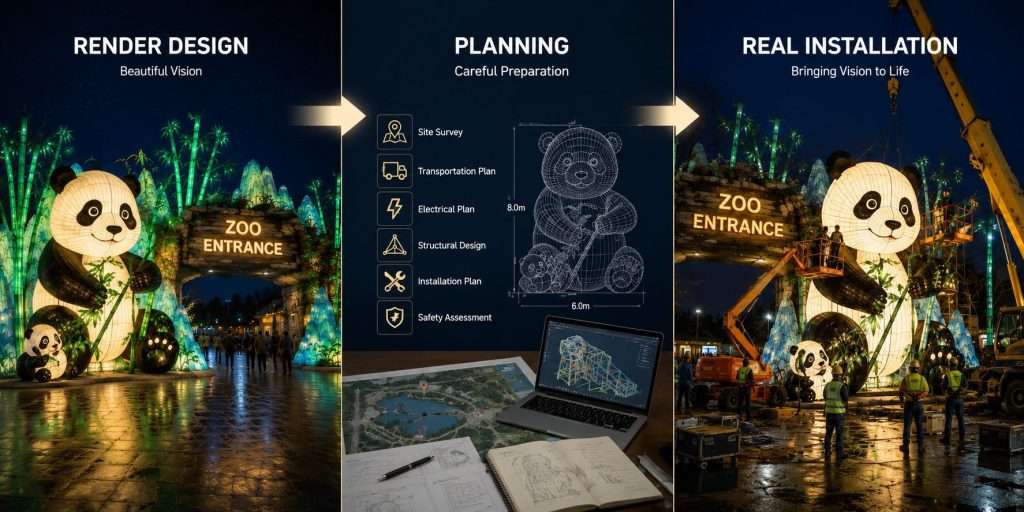
A lot of delays and extra expenses in the process of project development can be attributed to some mistakes made in the initial stage of planning. On the basis of our experience in producing and installing custom lantern shows, we can highlight six major challenges.
1. Site Conditions Are Often Different from the Drawings
Most projects start with a site layout or CAD drawing. While helpful, there is more information than this available on any given project site.
Such information includes mature trees, topography, bodies of water, current light posts, underground utilities, or irregular terrain, which could make it difficult for large lanterns to be placed as intended.
Projects such as those which involve installing a huge animal lantern that requires redesign due to mature trees interfering with the viewing point are not uncommon.
Another situation involves an increase in installation time due to unstable terrain preventing the use of heavy machinery.
Recommendation: Before production starts, ensure you have the most up-to-date site photos, videos, dimensions, and installation details. A site survey is advised for large installations.
2. Transportation Is More Complicated Than Many Buyers Expect
A lantern may fit perfectly inside the factory but still be impossible to transport.
Big animal lanterns usually have to move past entrance gates, bridges, tunnels, or small pathways in parks before they reach their installation location. Without transportation being taken into account at the design stage, oversized lanterns might have to be altered urgently.
To avoid these problems, we design many large lanterns with modular structures. Each section is engineered for safe transportation while allowing quick assembly after arrival.
Planning transportation early also helps determine:
- Module size
- Truck or container requirements
- Lifting equipment
- Installation sequence
These details can significantly reduce installation time and risk.
Image Suggestion: Large panda lantern divided into transportable modules.
Alt: Modular lantern transportation
3. Power Planning Should Start Before Production
Power supply is one of the most underestimated parts of a lantern festival project.
Many organizers finalize the artistic design first and only begin planning electrical systems shortly before installation. By then, the location of power cabinets, cable routes, and total electrical load may no longer match the design.
This often results in additional wiring, higher installation costs, and project delays.
During project planning, we recommend confirming:
- Total power consumption
- Power distribution locations
- Cable routing
- Control system layout
- Waterproof electrical protection
Electrical planning should be developed alongside the lantern design—not after production has started.
4. Weather Conditions Affect More Than Appearance
Outdoor lantern festivals must perform in real environmental conditions, not just on opening night.
Strong winds, heavy rain, intense sunlight, humidity, and coastal salt air all influence structural design and material selection.
For example:
- Coastal projects benefit from corrosion-resistant materials.
- High-wind areas require stronger internal reinforcement and more secure foundations.
- Hot climates demand UV-resistant fabrics that maintain their color throughout the event.
Rather than using the same materials for all projects, the manufacturing process needs to be modified depending on the surrounding environment.
It will help avoid maintenance in the long run and increase the longevity of the display.
5. Maintenance Should Be Planned Before the Festival Opens
Many people focus on installation but rarely think about maintenance during a two- or three-month exhibition.
Is the light part easy to access when you want to change it? Is the electrical wire easy to inspect without having to dismantle the entire lantern?
These are some of the things you should find out when you are designing your project.
While designing at AuroraGong, we look at maintenance of the structure. With the modular design and proper wiring, the lantern becomes easier to repair and inspect during the festival.
6. Installation Time Is Often Underestimated
Many buyers assume installation simply involves placing finished lanterns on-site.
But in actuality, installation entails removal, placement, assembly of the modules, electrical connections, light effect tests, and final safety inspections.
If no prior planning has been done, even a well-manufactured lantern may take far longer to be installed than anticipated.
To increase efficiency in the process, we usually do a trial assembly of the lantern before shipping. All the modules are numbered, and electrical connections are tested and verified before packaging.
Conclusion
Stunning renditions are just the start of a well-planned lantern festival; making them practical and durable outdoors is where the real work lies.
With proper planning that considers everything from logistics to site conditions, weather, installation, and power, you’ll have a more manageable event with reduced risk and lower costs.
At AuroraGong, we know that all successful lantern festivals start with meticulous planning. Our goal is not only to manufacture custom lanterns but also to help clients deliver projects that perform reliably from installation day to the final visitor.