
With the continued growth of the global nighttime economy, Ocean Light Shows are gradually becoming an important way for theme parks, aquariums, seaside resorts, and cultural tourism complexes to enhance their nighttime appeal. Compared to traditional static lighting, modern tourists expect a more immersive and interactive ocean experience.
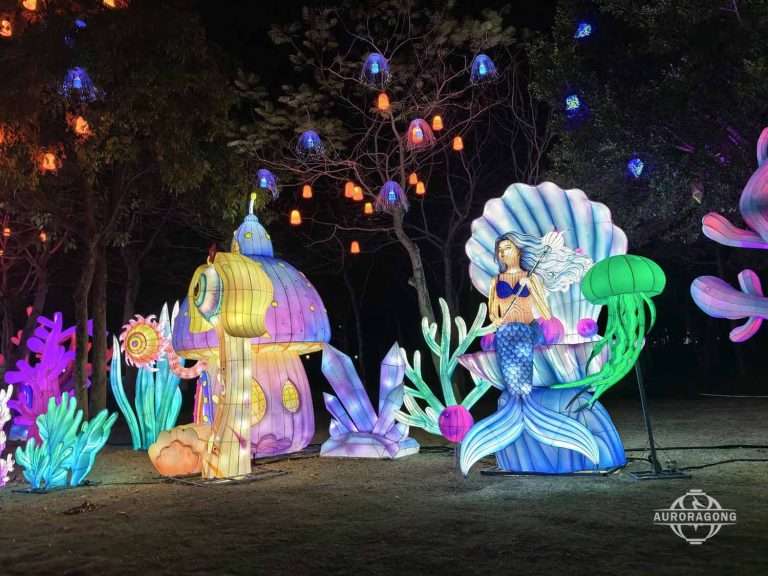
For project operators, a successful sea animal lantern is not just visual decoration, but a complete narrative system. From spatial planning to interactive design and construction, every step determines the length of visitor stay, social media impact, and commercial conversion rate.
Using arched wave-shaped light displays and dynamic blue light to create a sense of “diving into the ocean.”
From Visual to Immersive
Many past ocean light shows simply displayed glowing whales, jellyfish, and dolphins, lacking any immersive or interactive elements.
A truly excellent ocean light show needs to establish a complete storyline:
Entrance Area: A Call from the Deep Sea
Using arched wave-shaped light displays and dynamic blue light to create a sense of “diving into the ocean.”
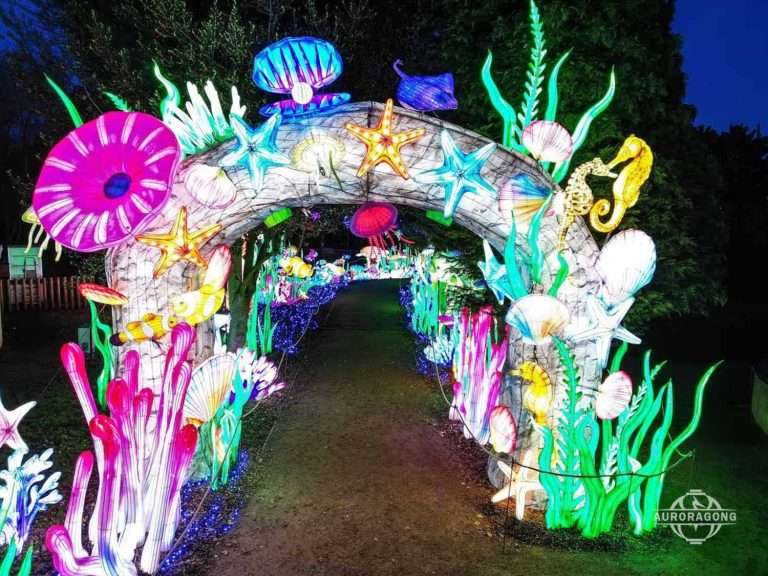
Core Area: Interactive Marine Life
Featuring large-scale sea animal lanterns, such as glowing whales, jellyfish matrices, coral forests, and shark tunnels, allowing visitors to immerse themselves in the experience.
Climax Area: Digital Interactive Performance
Combining a synchronized sound and light system to achieve interactive effects such as wave rhythms, fish tracking, and touch-sensitive color changes.
Exit Area: Creating Brand Memorability Points
Incorporating IP ocean characters, photo spots, and related consumption areas.
This narrative layout significantly extends visitor dwell time and increases social media sharing.
Key Elements for Designing an Immersive Ocean Light Show
Unified Ocean-Themed IP Visuals
Visitors remember not just individual lights, but the complete worldview.
Design should revolve around:
- Deep Sea Secrets
- Polar Ocean Adventures
- Dreamy Coral Kingdom
- Ocean Environmental Theme
- Illuminated Underwater City
A unified color scheme (blue, purple, and cyan gradient) enhances the immersive experience.
Scale Control for Large Sea Animal Lanterns
Many projects fail due to size imbalance.
Experience suggests:
- Main sculpture recommended height: 6–15 meters
- Aisle lighting recommended height: 3–5 meters
- Interactive installations optimal reach height: 1.2–1.8 meters
As a professional manufacturer of sea animal light display lanterns, AuroraGong utilizes a modular steel frame design, enabling rapid transportation and on-site assembly of large lanterns while ensuring structural safety and wind resistance.
Dynamic Lighting Control System
Static lighting is no longer sufficient to meet visitor expectations.
High-quality ocean light shows typically combine:
- RGB gradient lighting effects
- DMX intelligent control
- Music synchronization system
- Interactive sensor triggering
- Fog and projection integration
This transforms the sea animal lantern from an “exhibit” into a “breathing marine life.”
How AuroraGong Delivers Reliable Ocean Light Show Projects?
In large-scale ocean light show projects, what truly determines success or failure is often not the creative sketches, but rather the engineering control capabilities at every execution stage, from initial concept to the actual lighting.
Through years of experience in international cultural tourism projects, AuroraGong has developed a mature, end-to-end engineering system to ensure the smooth implementation of ocean light shows from concept to opening.
Initial Concept Planning
Many clients initially only state their need: “We want to create an ocean-themed light show.” However, a truly professional planning stage requires answering the following questions:
- Who is this Ocean Light Show for?
- How long will visitors stay?
- Where are the photo and sharing points?
- How should peak-hour traffic flow be organized?
- How will secondary nighttime spending be generated?
At the project initiation stage, we consider:
- Site clearance and span
- Visitor flow model
- Basic nighttime illumination of the venue
- Local climate conditions (sea breeze, humidity, rainfall)
- Operating cycle (short-term exhibition/seasonal exhibition/year-round operation)
to determine the layout of the light installations.
For example, seaside resort projects typically emphasize “long-distance visual appeal,” requiring highly recognizable whale or giant jellyfish main installations; while aquariums emphasize close-up interactive experiences, employing low-lying immersive coral and fish pathway designs.
This step directly determines whether the subsequent design direction has commercial value.
3D Creative Deepening
A common problem in the industry is that design teams only know how to render, not how to structure.
When our design team outputs ocean-themed visual solutions, we consider the following simultaneously:
- Distribution of load-bearing points on the lamp body
- Strength logic of the steel frame
- Uniformity of light transmission on the luminous surface
- Module disassembly and transportation dimensions
- On-site assembly interface locations
For example, with large sea animal lanterns, especially whale-shaped ones, the large span of the belly’s curved line means that if only visual smoothness is pursued while neglecting the steel frame support, local collapses or deformation of the light fabric can easily occur on-site.
Therefore, we complete structural pre-visualization in the 3D stage, ensuring that the creative design has realistic construction feasibility.
Structural Detailing and Prefabrication
For overseas projects, on-site construction time is often extremely limited. Our standard practice is to complete over 80% prefabrication and assembly in the factory, retaining only modular splicing interfaces.
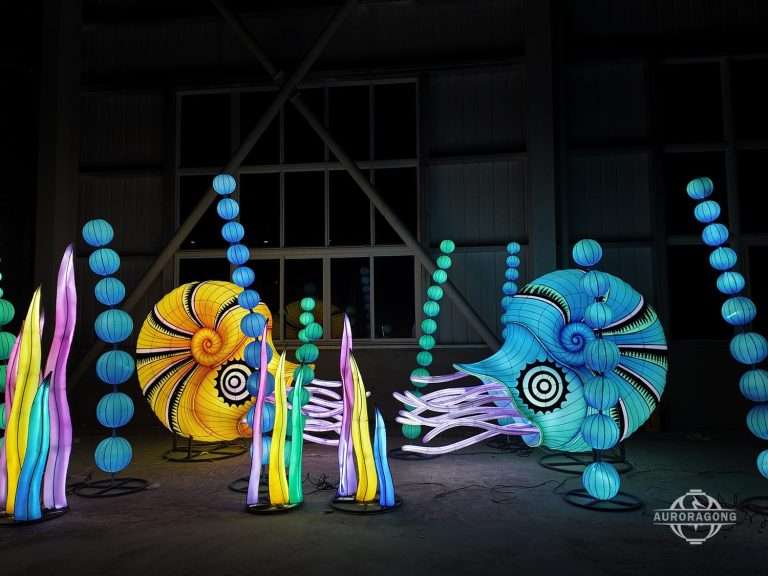
Each light assembly generates:
- Steel structure numbering diagram
- Wiring logic diagram
- Installation sequence diagram
- Weight distribution table
- Windproof reinforcement detail diagram
This means that even for first-time installations, the client’s on-site team can complete the process quickly. This system typically shortens the installation cycle by 30%-45% and significantly reduces overseas labor costs.
Craftsmanship and Lighting Integration
The difference in quality in the Ocean Light Show is immediately apparent to visitors. Truly high-quality sea animal lanterns are characterized by:
Layered Painting: Marine life must have a gradient of transparency, not just flat paint.
Fabric Tension Control: Insufficient tension results in wrinkles, affecting the even diffusion of light.
Light Spot Algorithm: Excessive spacing errors lead to noticeable bright spots, disrupting the sense of ocean movement.
Our team of artisans adjusts the hand-sculpting based on the textural characteristics of marine life, combining this with an intelligent DMX control system to achieve:
- Dynamic Wave Breathing
- Schools Following the Light
- Jellyfish Gradually Fading Away and Floating
- Sound and Light Synchronized Performance
This makes the Ocean Light Show not just “bright,” but truly “alive.”
Ocean Light Show Transportation and On-site Delivery
Many large-scale light show projects fail during the final delivery stage.
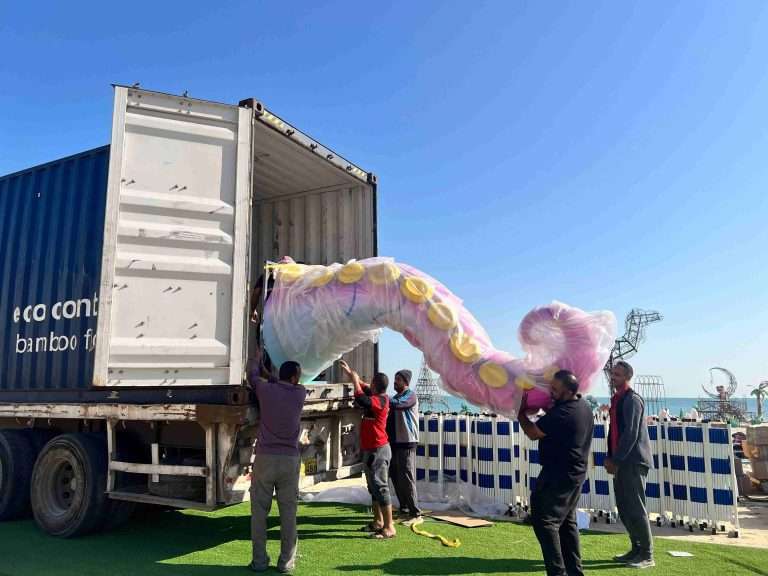
AuroraGong provides:
- Optimized container loading
- Overseas customs clearance assistance
- Installation video guidance
- Remote engineer support
- On-site technical supervision when necessary
This closed-loop delivery model ensures that clients do not need to coordinate multiple suppliers from signing the contract to the official opening.
This is why more and more international theme parks, when planning ocean light shows, prefer to choose AuroraGong, which has a complete engineering delivery system, rather than simply looking for an ordinary sea animal lights display lantern manufacturer.