
Customized koi fish lanterns are no longer just aesthetic items for decoration. Today’s festival design uses fish lanterns as a form of engineering construction that integrates culture and safety, while offering high efficiency using LED technology. Such lantern installations have become popular at night festivals, cultural tourism, commercial squares, and thematic entertainment centers, places where appearance and reliability matter equally.
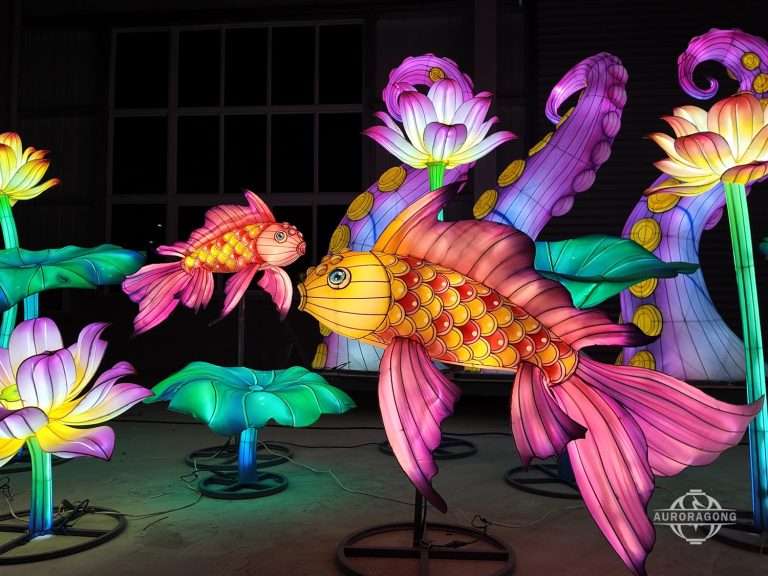
Professional creation of a koi fish lantern installation is a systematic process, which helps to implement design creativity into reliable and weather-proof installations.
1. Project Consultation & Site Evaluation
Every custom fish lantern project begins with detailed communication between the client and our design and engineering teams.
Before creating the concept, we carefully evaluate:
- Event type and theme
- Installation purpose
- Expected visual effects
- Indoor or outdoor application
- Site dimensions and visitor flow
- Local weather conditions
- Wind load requirements
- Power supply availability
- Installation timeline
For outdoor lantern displays, environmental factors such as rain exposure, wind resistance, and long-term operational stability are especially important.
This early-stage evaluation helps us determine the feasibility, structural requirements, and lighting strategy of the koi fish lantern installation before production begins.
2. Concept Design & 3D Visual Development
Once the project requirements are confirmed, our creative team develops a detailed visual concept for the custom koi fish lantern display.
Depending on the project theme, we may design:
- Cultural or festival-themed lantern scenes
- Traditional koi fish lanterns
- Giant illuminated fish sculptures
- Floating fish lantern installations
- Interactive RGB fish displays
To help clients clearly visualize the final result, we provide:
- Hand-drawn concept sketches
- Professional 3D renderings
- Lighting simulation previews
- Daytime and nighttime visual effects
- RGB color-changing demonstrations
- Site layout planning
During this stage, lighting behavior and visitor viewing angles are carefully considered to maximize the nighttime visual experience.
The goal is to finalize the artistic direction and technical feasibility before entering engineering and production.
3. Structural Engineering & LED Lighting System Design
Structural Engineering for Koi Fish Lanterns
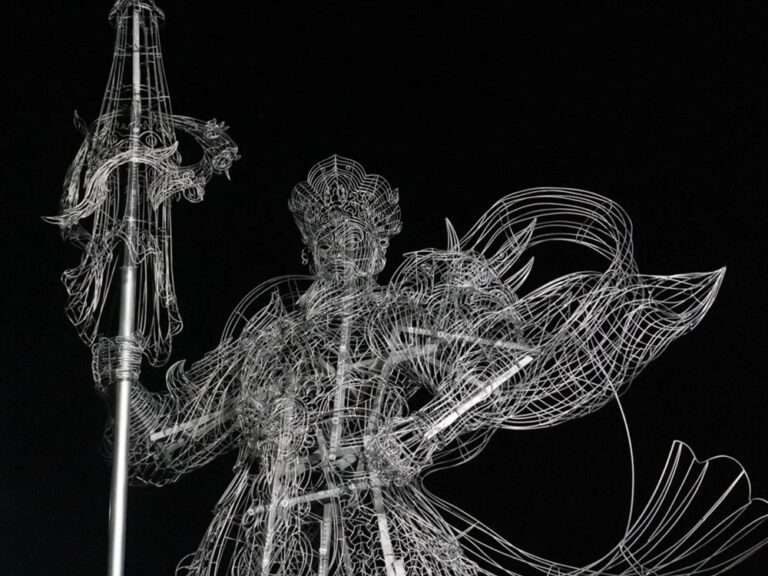
Large-scale fish lantern installations require professional structural engineering to ensure safety and stability.
Our lantern structures are typically built using:
- Galvanized steel frames for primary support
- Aluminum alloy reinforcement to reduce weight
- Fiberglass components for complex curved surfaces
- Modular structural sections for easier transportation
Engineering calculations include:
- Wind load analysis
- Weight distribution
- Center-of-gravity balance
- Suspension safety
- Modular assembly planning
For large lantern installations, structures are commonly divided into 1.5m–3m modular sections to simplify transportation and on-site assembly.
Professional LED Lighting System
Modern koi fish lantern displays rely heavily on advanced LED lighting technology.
Our lighting systems typically include:
- IP65 waterproof LED modules
- Energy-efficient LED strip systems
- Programmable RGB lighting effects
- DMX512 control systems
- Customized lighting controllers
- Low-voltage 12V or 24V systems
The LED systems are designed not only for brightness, but also for:
- Color consistency
- Lighting synchronization
- Dynamic animation effects
- Long operational lifespan
- Energy efficiency
Depending on the project configuration, LED lifespan generally ranges from 30,000 to 50,000 hours.
4. Material Selection for Long-Term Outdoor Performance
One important aspect that will affect the performance of each fish lantern is material selection. Here, all of the koi fish lantern and structural materials used will be confirmed for the final products’ use in actual environmental conditions.
Standard Production Material
The standard materials used during our production processes are as follows:
- High-grade steel for structural frame construction
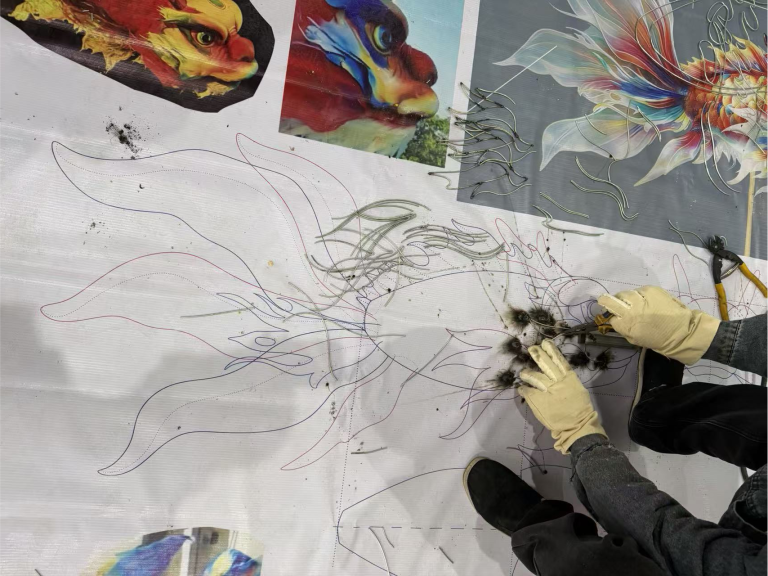
- Galvanized iron wire for form making and reinforcement
- Environmentally friendly and power-saving LED bulbs for lighting
- Flexible LED light strip for dynamic light effect generation
- High-grade silk cloth for finishing exterior surfaces
- Acrylic waterproof paint for coloring and protecting surfaces
Selection of Materials Based on Project Conditions
The selection of materials is determined by the project conditions, such as weather exposure outdoors, lighting requirements, the size of the installation, and whether the project is temporary for festivals or permanent.
This guarantees that the completed project will function well under practical conditions while retaining its visual appeal at night.
Confirmation of Pre-Production and Change Policy
It is recommended that the clients examine all material options and specify any special requirements prior to production. Optimization at this point is strongly encouraged to ensure that the final product meets the required standards.
On the other hand, once production starts, modifications cannot be made to any structural and material parameters because of limitations imposed by the manufacturing process.
Modular Construction and On-Site Assembly
Once the design has been confirmed, production will be done in modules for proper assembly and ease of transportation. All modules are prefabricated in the factory to check for structural and lighting precision.
5. Production Confirmation & Manufacturing Process
Before production begins, all technical drawings, materials, lighting systems, and dimensions are confirmed with the client.
We strongly recommend finalizing:
- Structural specifications
- Surface materials
- Lighting effects
- Animation requirements
- Installation methods
- Transportation plans
Because large-scale lantern manufacturing involves customized structural fabrication, modifications after production begins may significantly affect production schedules and engineering integrity.
6. Modular Fabrication & Factory Quality Testing
Modular Lantern Production
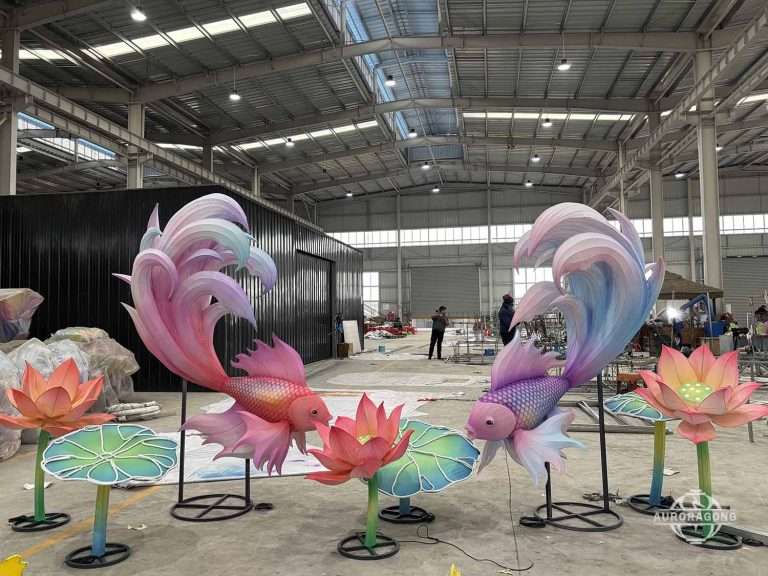
To simplify global transportation and on-site installation, all koi fish lantern systems are manufactured as modular sections.
Each module is pre-assembled in our factory to verify:
- Structural accuracy
- Lighting consistency
- Electrical safety
- Installation compatibility
Factory Testing & Quality Control
Before shipment, every lantern system undergoes comprehensive testing procedures.
Our standard testing process includes:
- Full structural pre-assembly
- LED lighting uniformity inspection
- Waterproof testing
- Electrical safety inspection
- Suspension and load-bearing tests
- 8–24 hour continuous lighting tests
For larger outdoor installations, additional wind-resistance testing may also be conducted.
These quality control procedures help minimize installation risks and improve long-term operational stability.
7. International Packaging & Transportation
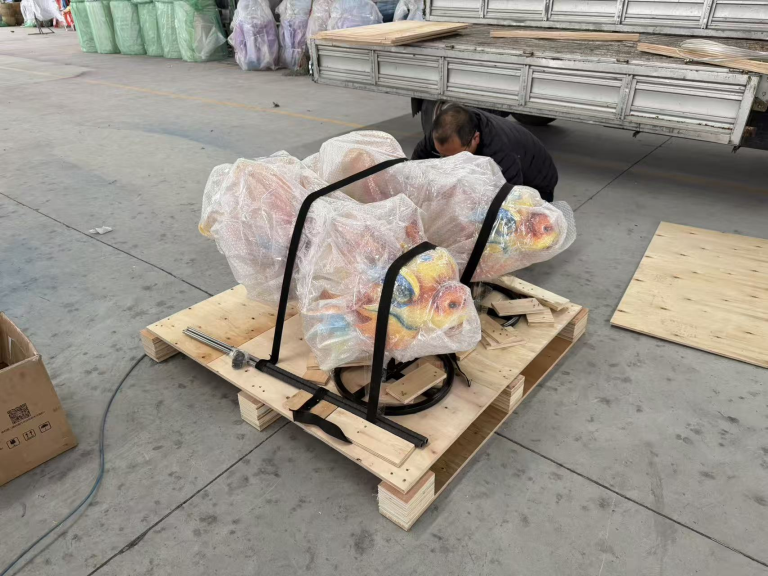
After testing is completed, the koi fish lantern installation is carefully disassembled into transport-ready modules.
Professional export packaging includes:
- Steel-frame protective crates
- Waterproof electrical protection
- Foam cushioning for lighting components
- Reinforced transportation supports
We also provide complete technical documentation, including:
- Structural assembly drawings
- Electrical wiring diagrams
- Site layout plans
- Foundation recommendations
- Installation instructions
For international projects, transportation planning is optimized to reduce shipping costs while protecting all lantern components during transit.
8. On-Site Installation & Final Lighting Calibration
Our installation teams follow a systematic process to ensure efficient assembly and safe operation.
The installation process generally includes:
- Foundation preparation
- Steel structure assembly
- Module connection and reinforcement
- Electrical system installation
- Fabric or surface covering installation
- Lighting programming and synchronization
- Nighttime lighting calibration
Final calibration is performed at night to optimize:
- Brightness levels
- RGB color transitions
- Animation timing
- Dynamic lighting effects
- Visitor viewing experience
This final adjustment stage is essential for creating immersive nighttime visual attractions.