
This trend is often observed when asking for quotes from suppliers: while the custom fiberglass model in question is identical, one supplier will offer to sell it for USD 1,000, another – USD 3,000, and yet another will be willing to ask for USD 5,000 for their fiberglass sculpture.
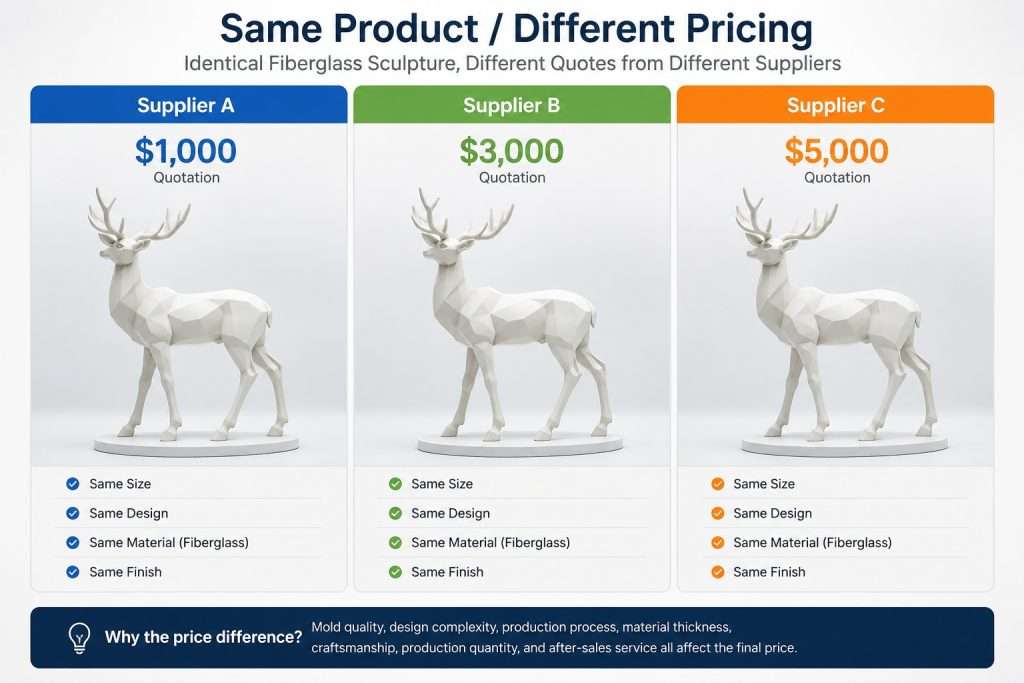
In reality, the price does not depend on the suppliers’ whims or caprices. In fact, most of it depends on the complexity of design, durability, manufacturing process, and technique itself.
1. Mold Size Is Only the Starting Point
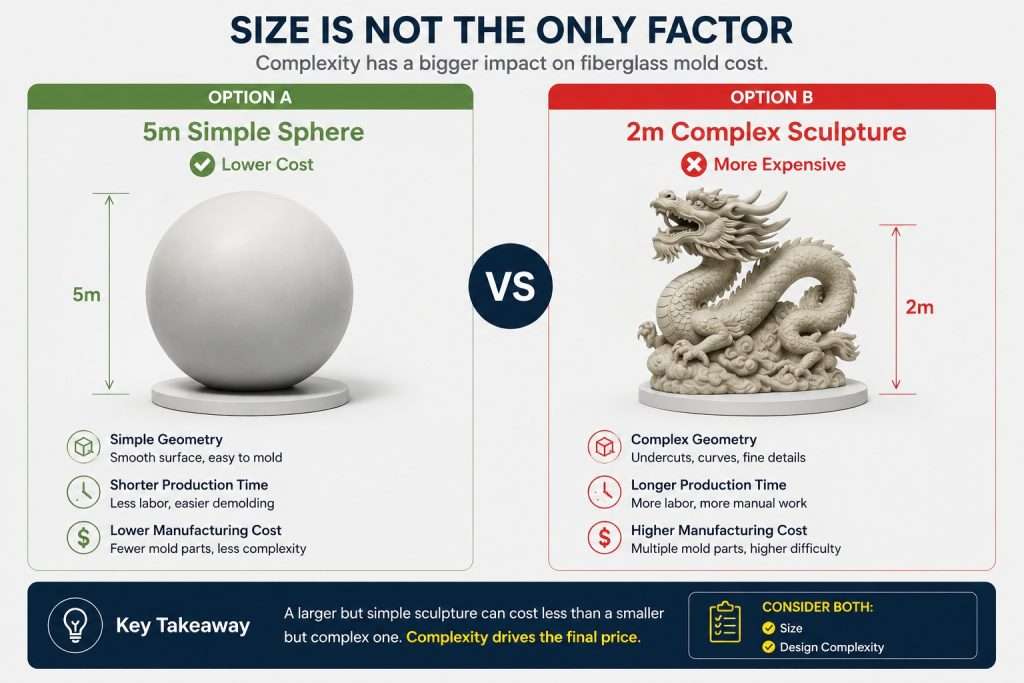
Many consumers believe that bigger fiberglass sculptures tend to be more expensive. Even though the size plays its role in the price formation process, it is just one of many factors involved.
A bigger mold needs more material, more resin, reinforcement, more area, and more efforts. Transportation and manipulation expenses may also increase.
Nevertheless, the size is not the determining factor of the price.
As an illustration, a relatively easy sphere of 5 meters can be produced easier than a sculpture of 2 meters with difficult texture and forms. When choosing among quotations, keep in mind both factors.
2. Complex Shapes Increase Manufacturing Costs
The geometry of the sculpture is often the biggest factor affecting mold cost.
Features that require additional work include:
- Deep undercuts
- Hollow sections
- Sharp curves
- Multiple removable mold sections
- Complex assembly structures
These details increase design time, mold splitting, manual finishing, and quality inspection.
A simple geometric sculpture may be completed much faster than a highly detailed animal or human figure, even if both are the same size.
3. Surface Details Require More Manual Work
Smooth surfaces are relatively easy to manufacture.
Highly detailed textures require significantly more manual craftsmanship.
Examples include:
Animal fur
- Human facial features
- Tree bark
- Stone textures
- Decorative carvings
- Architectural relief patterns
Every small detail must be accurately reproduced in the mold. This increases sculpting, polishing, inspection, and repair time before production begins.
In many projects, labor—not raw materials—is the largest cost component.
4. Production Quantity Changes Mold Requirements
Not every mold is built for the same purpose.
If only one or two fiberglass sculptures will be produced, a prototype mold may be sufficient.
However, molds intended for repeated production often require:
- Stronger structural reinforcement
- Thicker fiberglass layers
- Higher-quality resin systems
- Better dimensional stability
- Longer service life
Although these molds cost more initially, they usually reduce maintenance and replacement costs during long production runs.
When requesting quotations, buyers should clearly communicate the expected production quantity.
5. Mold Construction and Reinforcement Matter
Two molds with identical dimensions can have very different internal structures.
Manufacturers may use different construction methods depending on project requirements.
Common differences include:
- Fiberglass thickness
- Internal steel frame reinforcement
- Supporting ribs
- Structural stiffness
- Overall durability
A lower-priced mold may use fewer reinforcement materials, making it suitable for limited production. A higher-priced mold may be designed for long-term industrial use with improved structural stability.
Understanding these differences helps explain why quotations may vary.
6. Mold Design Affects Manufacturing Difficulty
The number of mold sections also influences pricing.
Simple products may only require a two-piece mold.
More complicated sculptures may require:
- Multiple removable sections
- Hidden parting lines
- Precision alignment systems
- Assembly fixtures
Additional mold sections increase engineering, manufacturing, assembly, and inspection time.
Although these designs are more expensive, they often make demolding easier and help protect delicate surface details.
7. Design Files Can Reduce Overall Costs
The information provided by the buyer can directly affect mold development costs.
If complete 3D files are available, such as STL, STEP, or OBJ formats, manufacturers can begin engineering much more efficiently.
If only photographs or sketches are provided, additional work may include:
- 3D modeling
- Design reconstruction
- Dimension estimation
- Engineering review
These extra design steps increase both development time and project costs.
Providing accurate digital files is one of the easiest ways to reduce mold expenses.
How to Compare Fiberglass Mold Quotes
Price alone should never be the only factor when evaluating suppliers.
Before making a decision, consider asking these questions:
- Is the quotation for the mold only or the finished fiberglass product?
- How many production cycles is the mold designed for?
- Does the mold include internal steel reinforcement?
- How many mold sections are required?
- Are 3D modeling costs included?
- Are design revisions included after approval?
- Does the quotation include mold testing before production?
- Who owns the mold after the project is completed?
Comparing quotations using the same technical standards provides a much clearer picture than simply comparing total prices.
FAQ
Q1. How long does it usually take to manufacture a custom fiberglass mold?
Lead time is dependent on the size and complexity of the project. The lead time can be as little as a few weeks for simpler custom fiberglass molds, whereas larger or more complex molds will usually need extra time.
Q2. Who normally owns the mold after production?
Ownership of the mold can be determined by the terms of the contract between the buyer and the manufacturer. While some buyers purchase the mold itself, there are others who only pay for production.
Q3. How long can a fiberglass mold last?
The service life of a mold depends on various factors such as design, construction, material, maintenance, and production rate.
Q4. Can damaged fiberglass molds be repaired?
Yes, that is possible in most cases. But minor damages can only be repaired while major damages can force you to reconstruct or even replace your mold.
Q5. What information should buyers prepare before requesting a quotation?
Having dimensions, 3D files, visual references, quantity required, surface finishing needs, and applications details ready will help manufacturers give more precise quotations and avoid changes.