
The right festival planning software is the difference between a light festival that opens on schedule and one that opens late. A lantern festival looks like an art project from the outside; inside, it is a supply chain project with a fixed, unmovable opening night.
That combination is rare and brutal. A software launch can slip two weeks. A product drop can be rescheduled. A ticketed winter light festival that opens on 28 November cannot slip to 12 December — the venue is booked, the marketing is spent, the school groups are scheduled, and the refund exposure is real. Every other decision in the project is downstream of that one date.
Over the last few years the scale of these events has grown faster than the planning habits behind them. A mid-size municipal light festival that used to involve 30 lantern sets now routinely involves 80 to 150, plus interactive elements, projection mapping, food and beverage, security, and a ticketing integration. The number of vendors has grown with it: fabricators, freight forwarders, rigging crews, electrical contractors, and the venue’s own operations team.
Most festival teams are still running that complexity out of a spreadsheet, a group chat, and someone’s inbox. It works — right up until it doesn’t.
Why planning software now decides whether a light festival opens on time
What makes lantern and light festival projects structurally different
Three characteristics separate festival delivery from ordinary project management, and they are exactly what should drive your software choice.
Fabrication happens months before installation, and usually on another continent. For custom lantern work, the design-to-install timeline commonly runs 4 to 7 months: concept and 3D design, engineering and frame fabrication, silk stretching and painting, crating, 6 to 8 weeks of sea freight, customs clearance, then on-site assembly. A task board that only tracks “installation” is tracking the last 12% of the project. The tool has to hold the manufacturing phase as first-class work, with milestone dates tied to shipping cutoffs rather than to internal meetings.


Every element is a physical asset with a lifecycle, not just a task. A 4-metre lantern set is specified, prototyped, photographed, crated, shipped, installed, maintained through a 60-night run, then either stored or refurbished. That is an asset record, not a to-do item. If your tools cannot hold “this is lantern set 47, here is its crate number, here is where it is stored” you will be rebuilding that information from memory every season — and for touring or annually recurring festivals, that memory loss is where the budget quietly leaks.
The team is a temporary organisation. The festival committee, the city liaison, the external fabrication partner and the on-site rigging crew will probably never work together again. Onboarding cost is therefore a recurring cost, not a one-off. Tools that need three days of training per new collaborator are more expensive than their licence fee suggests.
The real cost of running a festival on spreadsheets and group chats
The failure mode is not dramatic. It is slow and expensive.
- Version drift. The lantern count in the design deck says 94. The procurement sheet says 88. The freight manifest says 91. Nobody knows which is right, and the discrepancy is discovered on site.
- Decisions without context. The choice to drop two interactive pieces was made in a voice note in week 9. In week 22 nobody remembers why, so the same debate happens again.
- Critical path invisibility. Customs clearance is the single highest-risk step in an international lantern project, and in a spreadsheet it is one row among two hundred, with no visible dependency on anything.
- Handover amnesia. Next year’s team inherits a folder, not a system, and relearns everything from scratch.
None of this is a tooling problem in the abstract. It is a visibility problem. The rest of this guide evaluates eight tools on how well they fix it.
How we evaluated these tools
Every tool below was scored against six criteria, weighted for the specific shape of festival delivery rather than for generic office work.
| Evaluation criterion | Weight | What we actually looked for |
|---|---|---|
| Timeline & critical path | 25% | Gantt, dependencies, milestones, baseline vs actual |
| Asset & vendor tracking | 20% | Can it hold a physical item record with status, location, owner |
| Cross-org collaboration | 20% | Guests, external vendors, permissions, mobile access for on-site crews |
| Documentation & decisions | 15% | Where does the “why” live — specs, approvals, meeting notes |
| Automation & integrations | 10% | Reduces manual status chasing; connects to email, drive, chat |
| Price & team fit | 10% | Free tier usefulness, cost at 10 / 50 / 200 seats |
Two biases worth declaring up front. We weighted asset tracking far higher than most project management software roundups do, because a lantern set is not a task. And we weighted external collaborator access heavily, because a festival team is mostly people who do not work for you.
Pricing below reflects publicly listed annual-billing rates per user per month as of early 2026. Vendors change pricing often — verify on the official page before you budget.
8 festival planning tools compared → 8 Festival Planning Software Tools Compared
| Tool | Best for | Free plan | Paid from | Timeline / Gantt | Asset & vendor tracking | Ideal team size |
|---|---|---|---|---|---|---|
| Smartsheet | Asset-heavy build & install tracking | 1 user, 2 editors | $9/user/mo | Strong | Excellent | 15–200 |
| Asana | Cross-department coordination | Up to 10 users | $10.99/user/mo | Good | Moderate | 10–500 |
| Monday.com | Visual status for non-technical stakeholders | Up to 2 seats | $9/user/mo | Good | Good | 5–300 |
| Airtable | Lantern inventory & vendor database | Up to 5 editors | $20/user/mo | Moderate | Excellent | 5–100 |
| ClickUp | All-in-one on a tight budget | Unlimited users | $7/user/mo | Strong | Good | 3–250 |
| Microsoft Project & Planner | Enterprises already on Microsoft 365 | With M365 licence | $10/user/mo (Plan 1) | Excellent | Moderate | 50–1,000+ |
| Notion | Specifications, decisions & handover docs | Unlimited (blocks) | $10/user/mo | Basic | Moderate | 3–60 |
| Trello | Small teams, single-site events | Up to 10 boards | $5/user/mo | Weak | Weak | 1–15 |
In-depth reviews
1. Smartsheet — the best fit for build and installation tracking
One-line positioning: a spreadsheet that grew up into a project system, and still thinks in rows — which is exactly what a physical asset list wants.
Smartsheet is the closest thing on this list to a purpose-built festival delivery tool, without being one. Its mental model is a grid: one row per lantern set, one column per attribute (design status, frame status, painting status, crate number, container, install zone, maintenance notes). That maps almost perfectly onto how fabrication teams already work, which is why adoption is faster here than in tools that demand you think in tasks first.
Where Smartsheet earns its price is dependency management. You can set “customs clearance cannot start until crating completes and the bill of lading is issued,” turn on the critical path, and then see in red exactly which slip pushes the opening night. For an international lantern project where freight and customs are the two steps that can silently eat three weeks, that visibility is worth more than any other feature on this list.
Pros
- Critical path and dependencies are genuinely usable, not decorative
- Grid model suits bill-of-materials and asset lists better than card models
- Forms let on-site crews submit maintenance issues from a phone without a licence
- Strong permissioning for external vendors at reasonable cost
Cons
- Interface feels dated next to Monday.com and Notion; expect some team resistance
- Automation is powerful but has a learning curve
- Per-user pricing gets expensive if you want every on-site crew member in the system
- Reporting is excellent but requires setup time you may not have in week one
Best real-world scenario: a botanical garden or zoo running a 6-month winter light festival with 60 to 150 lantern sets sourced from an overseas fabricator, where one person is accountable for the master asset list. Smartsheet becomes that list, and the Gantt on top of it keeps the shipping cutoffs honest.
2. Asana — the safest choice for coordinating many departments
One-line positioning: the tool most likely to be adopted by people who have never used a project management tool before.
Asana’s strength is not raw power, it is low friction. The interface is clean, the onboarding is short, and the Timeline view gives you dependency-aware Gantt without the density of Microsoft Project. For a festival committee that includes a marketing lead, a city liaison, a finance officer and an operations manager — people with wildly different technical comfort — that matters more than feature depth.
For festival work, Asana performs best as the coordination layer rather than the asset system. Use it to run the marketing calendar, the permitting milestones, the sponsor deliverables and the venue liaison. Custom fields let you tag tasks by zone or vendor, and rules automate the routine status chasing that otherwise eats a coordinator’s week.
Pros
- Shortest onboarding of any serious tool here; new collaborators are productive in an afternoon
- Timeline view with dependencies covers most festival planning needs
- Rules and forms automate status collection from external partners
- Excellent mobile app for walk-throughs and on-site snag lists
Cons
- Asset tracking via custom fields works but is not relational — no “this lantern belongs to that container” logic
- Advanced features (portfolios, workload) are gated behind the higher tiers
- Cost escalates quickly past 25 users
- Not designed for holding large structured inventories
Best real-world scenario: a city council or business improvement district delivering a light trail across multiple public sites, where six internal departments and four external contractors all need to see the same calendar but nobody has time for training.
3. Monday.com — the best status visibility for non-technical stakeholders
One-line positioning: a colour-coded command board that executives and sponsors actually understand at a glance.
Monday.com sells on visual clarity, and for festival work that is not a superficial benefit. A sponsor, a venue director or a city official will not log into a Gantt chart. They will look at a board where every lantern zone is red, amber or green. Monday makes that board easy to build and hard to misread.
Underneath, boards are flexible databases. You can run one board for the lantern inventory, one for the vendor contracts, one for the marketing campaign, and link them. Automations are template-driven and approachable, which means a coordinator can build “notify the ops lead when install status changes to delayed” without writing anything.
Pros
- Status communication to non-technical stakeholders is best in class
- Automation recipes are genuinely no-code and quick to set up
- Board templates shorten setup for recurring annual events
- Dashboards combine multiple boards into one sponsor-facing view
Cons
- Pricing is seat-based with minimum seat tiers on some plans — check the fine print
- Very large boards (500+ items) can feel sluggish
- Dependency and critical path handling is weaker than Smartsheet or MS Project
- Feature gating across tiers means the plan you need is often not the cheapest one
Best real-world scenario: a shopping centre or destination marketing organisation running a seasonal light installation where the internal team is small (5–15) but the number of external stakeholders who need status updates is large.

Illuminated purple owl lantern displayed at a night festival entrance with visitors taking photos as a popular photo attraction. Designed for garden light festivals, zoo night tours, and theme park entrance attractions.
4. Airtable — the best home for your lantern inventory
One-line positioning: a relational database wearing a friendly interface — the right place for “what do we own, where is it, what condition is it in.”
Airtable is not really a project management tool, and that is fine. It is the tool you use to build the single source of truth about your physical assets, and then link it to whatever runs your schedule.
For an organisation that runs a lantern festival annually, Airtable is arguably the highest-leverage item on this list. Build one table for lantern sets (dimensions, weight, power draw, IP rating, photos, storage location, purchase year), one for containers and shipments, one for maintenance history, and one for venues. Link them. Now, when the 2027 planning starts, you are not asking “what did we run last year and what condition was it in” — you are filtering a database. Over three seasons that alone can save five figures in avoided re-purchases and emergency repairs.
Pros
- Relational linking is unmatched here — true parent/child records for assets and shipments
- Attachment and image fields make it a visual catalogue, not just a list
- Interface Designer lets you build a simple view for on-site crews who should not see the whole database
- Automations and forms cover most status-collection needs
Cons
- Most expensive per user on this list at the paid tiers
- Not a scheduling tool — you still need a Gantt somewhere else
- Row limits on lower tiers can bite a 150-item inventory with photos
- External collaborator permissions are less flexible than Smartsheet’s
Best real-world scenario: a venue or operator that owns its lantern inventory and runs the same festival every year, especially if pieces are stored, refurbished and re-deployed across seasons.
5. ClickUp — the most functionality per dollar
One-line positioning: one app that genuinely tries to replace five, and mostly succeeds at a price that is hard to argue with.
ClickUp’s pitch is consolidation, and for a festival team on a tight budget it is a real pitch. Tasks, docs, Gantt with dependencies, time tracking, forms, dashboards, chat, and a whiteboard — all in one licence at roughly a third of the cost of a comparable stack. The free tier is unusually generous, which makes it the obvious pilot candidate.
The trade-off is complexity. ClickUp has an enormous feature surface, and an unconfigured ClickUp workspace is a liability: too many views, too many hierarchy levels, and a team that quietly reverts to email. If you choose ClickUp, budget real setup time and appoint one person as the workspace owner. Teams that do this get excellent value. Teams that don’t get an expensive mess.
Pros
- Best price-to-functionality ratio on this list by a wide margin
- Gantt, dependencies, docs and dashboards all included at the Business tier
- Free tier is generous enough to run a real pilot
- Highly configurable hierarchy (Workspace → Space → Folder → List → Task)
Cons
- Configuration burden is significant; without an owner it degrades fast
- Performance can be inconsistent on large lists
- So many options that onboarding non-technical collaborators takes effort
- Feature breadth sometimes comes at the cost of polish in individual features
Best real-world scenario: a small-to-mid festival production company (3–40 people) that wants one login instead of five and has someone willing to own the setup for two weeks before the season starts.
6. Microsoft Project & Planner — the enterprise default
One-line positioning: if your organisation already pays for Microsoft 365, this is the cheapest credible answer — and for very large programmes, still the most rigorous.
Two products worth separating. Planner is included in many Microsoft 365 business plans and covers straightforward task and board coordination. Project — Plan 1, Plan 3 and Plan 5 — is the heavyweight: resource levelling, true critical path, baselines, and portfolio roll-up across multiple events.
For a single festival, Project is usually overkill. For a municipal authority running a light festival, a summer events programme and a capital works schedule in the same year, with shared crews and shared budget, the portfolio view is genuinely valuable — and it is the only tool here that handles resource contention across concurrent events convincingly.
Pros
- Zero marginal cost if Planner is already covered by your Microsoft 365 licence
- Critical path, baselines and resource levelling are the most rigorous here
- Enterprise security, compliance and data residency satisfy public-sector procurement
- Integrates with the rest of Microsoft 365, which your finance team already uses
Cons
- Steep learning curve for Project; Planner alone is too light for complex delivery
- Weak for asset catalogues and visual inventories
- Collaboration with external vendors is clunky without careful tenant configuration
- Licence tiers are confusing to buy
Best real-world scenario: a city, a large attraction group or a public-sector body with Microsoft 365 already deployed, strict IT and procurement requirements, and multiple concurrent events to coordinate.
7. Notion — the best place for decisions, specs and handover
One-line positioning: where the “why” lives — specifications, approvals, and the document your successor will thank you for.
Notion is not a project tracker, and buying it as one is the most common mistake teams make with it. It is a documentation and knowledge system with just enough database functionality to be dangerous.
Used correctly in a festival context, Notion holds: the design brief and reference imagery, the specification for each lantern set, the meeting log with decisions and rationale, the vendor contact list, the site operations manual, and — critically — the post-event debrief. When the 2027 committee convenes, they read one workspace instead of interviewing three people. For an event whose team dissolves and reforms every year, that continuity is worth a lot.
Pros
- Best-in-class for specifications, meeting notes and decision logs
- Flexible databases cover light tracking needs without a second tool
- Templates and AI search make historical decisions findable
- Very low cost for small teams; free tier is usable
Cons
- Gantt and dependency features are basic; do not plan a critical path here
- Page nesting gets disorganised without disciplined structure
- Not designed for external vendor collaboration at scale
- Performance slows with very large databases
Best real-world scenario: any festival team that has ever asked “why did we do it that way last year?” — which is to say, nearly all of them. Pair it with a real scheduling tool rather than using it alone.
[LINK-BLOCK — DELETE AFTER USE]
INTERNAL LINK → anchor text: winter festival lantern ideas → target: existing blog post “From Christmas Light Sculptures to Winter Festival Lanterns”.
Why here: your strongest existing internal link for this article — keep it in a content/ideation context, not a logistics one.
8. Trello — the right amount of tool for small events
One-line positioning: a digital wall of cards, and for a single-site event with a handful of people, that is genuinely enough.
Trello’s virtue is that it does not pretend to be more than it is. For a one-weekend light installation, a small community festival, or a single zone of a larger event, a board with lists like “Concept → Approved → In fabrication → Shipped → Installed → Live” is clear, fast, and requires no training whatsoever.
The ceiling arrives quickly. Once you need dependencies, cross-board reporting, or an asset list with more than a few attributes, Trello starts fighting you. Power-Ups add functionality but also add cost and complexity, and at that point a ClickUp or Monday.com licence is usually better value.
Pros
- Zero learning curve; anyone can use it in five minutes
- Free tier is sufficient for small, single-board projects
- Excellent for visual, stage-based workflows
- Butler automation on paid tiers is simple and useful
Cons
- No native dependencies or critical path
- Poor for structured asset data beyond labels and checklists
- Gets unwieldy past a few hundred cards
- Reporting across boards is limited
Best real-world scenario: a small team delivering a single-site installation, or a large festival team using Trello for one narrow workflow (for example the marketing asset approval board) while the master schedule lives elsewhere.



How to choose: recommendations by team size and project type
Under 10 people, single event
Stack: Trello or ClickUp free tier + Notion for the specification and debrief. Do not buy seats you will not use. The risk at this size is not missing features, it is failing to write anything down. Spend your effort on the Notion workspace, not on the tracker.
10–50 people, one annual festival
Stack: Asana or Monday.com + Airtable for the inventory. This is the most common shape for a botanical garden, zoo or mid-size attraction. You need a scheduling tool everyone will actually use, and a separate place to hold what you own. Keep the two linked manually or via automation — do not try to force one tool to do both badly.
50–200 people, multiple sites
Stack: Smartsheet or Microsoft Project + Notion + a guest-friendly chat tool. At this scale the master asset list and the critical path become the two things that cannot fail. Smartsheet handles both if you configure it well; Microsoft Project wins if you are already in the Microsoft ecosystem and need resource levelling across concurrent events.
Recurring or touring festivals
Stack: Airtable (inventory) + Smartsheet or Asana (schedule) + Notion (handover docs). Non-negotiable. If your festival runs every year, or your lantern sets travel between venues, the inventory database is not optional — it is the asset. Rebuilding it from memory each season is the single largest avoidable cost in this category.
A practical stack for a 6-month lantern festival timeline
Tools matter less than knowing what to track in which phase. Here is a working division.
Phase 1 — Concept and design (months 1–2). Notion holds the brief, inspiration, zone plan and specification. Asana or Monday tracks design approvals with the client. Deliverable: a signed-off lantern list with dimensions and power requirements.
Phase 2 — Fabrication (months 2–4). This is the phase most teams under-manage. Airtable or Smartsheet holds one row per lantern set with design / frame / painting / QC status. Weekly photo updates attach directly to the record. Deliverable: a complete, photographically documented inventory before anything is crated.
Phase 3 — Freight and customs (months 4–5). Smartsheet’s critical path earns its keep here. Track crating completion, container booking, vessel departure, arrival, customs clearance and inland delivery as linked milestones with dependencies. Deliverable: a customs-clearance contingency of at least 10 working days that is visible on the Gantt, not hidden in someone’s head.
Phase 4 — Installation and run (months 5–6+). Switch to mobile-first tools. A Smartsheet or Airtable form lets on-site crews report damage or outages from a phone in under 30 seconds. Asana or Trello runs the nightly snag list. Deliverable: a maintenance log that feeds directly into next year’s refurbishment budget.
The pattern: documents in one place, assets in a database, schedule in a Gantt, and on-site reporting through a form. One tool rarely does all four well.
What we do differently: an AI-assisted client workspace
Every tool in this comparison is designed for one team managing itself. None of them solves the problem that causes the most friction in a cross-border lantern project: the client cannot see what is happening.
That gap is structural, not accidental. Your fabricator is 11,000 kilometres away, working in a different language, in a time zone that overlaps your working day by about two hours. Every week that passes without a clear status update creates a small amount of anxiety, and anxiety turns into status meetings, and status meetings turn into a calendar that nobody has time for. The tooling above does not fix this because the client is, in every one of these products, a guest with limited access to someone else’s system.
So we built the layer that sits between our factory floor and your planning team. We run our custom lantern projects inside an AI-assisted client workspace.
[CONFIRM BEFORE PUBLISHING — DELETE AFTER USE]
1. Does the workspace have an official name? If yes, name it here and use it consistently.
2. Confirm which of the three AI functions below are live today. Cut anything that is not.
3. Confirm it is offered to all custom-project clients, not just selected accounts.
What it actually does
One live record per lantern set. Every element in your order — lantern set, archway, interactive piece — has its own record with a status that moves from design through engineering, fabrication, painting, quality control, crating, shipping, customs and installation. You open a link and see where all 87 pieces are. No software to install, no licence to buy, no training.
AI-assisted weekly updates. Our production team photographs the floor weekly. The system matches each batch of images to the right lantern record and generates a progress summary in English, so you get a written update without waiting for anyone to write one. This is the part that removes the meeting. The information arrives whether or not two calendars happen to overlap.
Milestone alerts with real lead time. Booking, vessel departure, arrival and customs clearance are tracked against the plan, and deviations raise a flag early — early enough that a three-week customs problem is still a manageable problem rather than an opening-night problem.
What it does not do
We are not going to tell you this replaces anything on the list above. It is not a planning engine and it does not run a critical path — internally we still manage the schedule in a proper Gantt, because that is the only honest way to hold a fixed opening date. The workspace is a visibility layer: it shows you the truth of the project without asking you to learn a tool.
It also does not change what matters most, which is starting early. A workspace that tells you clearly that your container is late is better than silence, but it is still worse than a container that was never at risk.
Why we did not just buy licences for our clients
We tried the obvious version first — invite clients into a commercial project tool as guests. Three things broke:
- Adoption. A venue operations manager will not learn a new tool for one project a year. The guest seat went unused and we were back to email.
- Cost. External seats add up fast on a project with a large stakeholder group, and that cost lands on the client for a tool they did not choose.
- Language and time zone. English-first interfaces and asynchronous handovers meant updates landed, but landed late and needed translation anyway.
A read-only workspace that requires no login discipline and arrives in the client’s own language solved all three. It is less sophisticated than Smartsheet and it is considerably more useful.

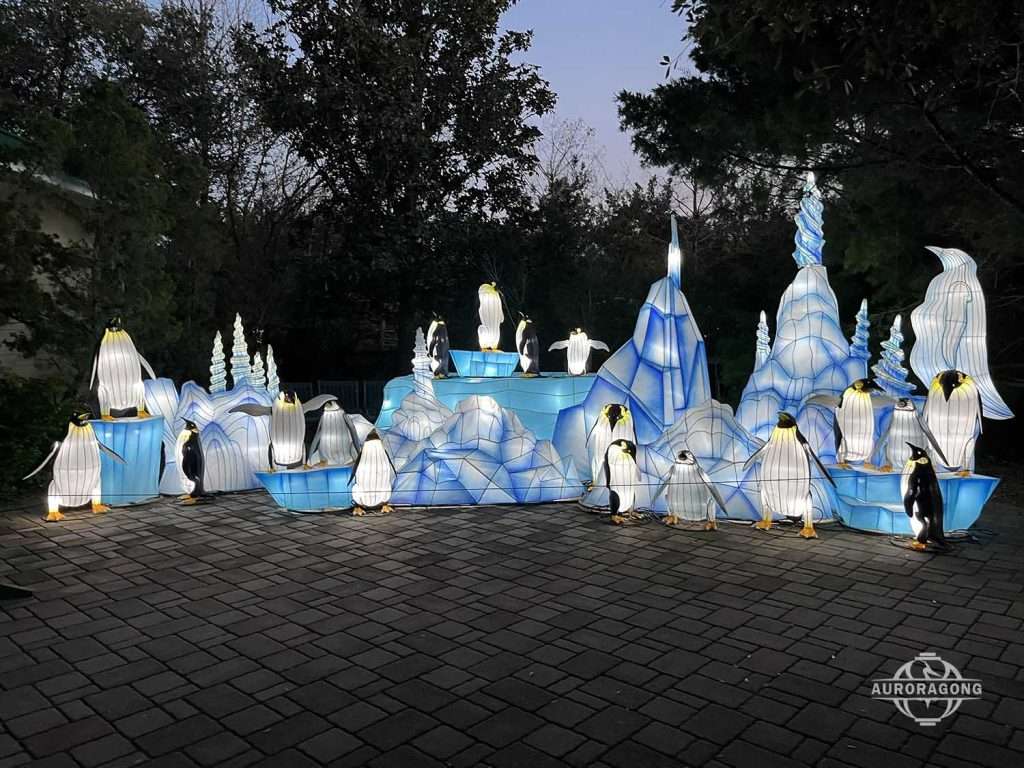
Penguin Lantern Family on Iceberg Platform – Arctic Light Display
FAQ
What is the biggest mistake teams make when choosing festival planning software?
Choosing the tool with the most features. Teams write a 40-item requirement list, pick the product that ticks the most boxes, and then use 20% of it. The better method is to name your three to five highest-risk moments — for a lantern festival that is usually design sign-off, shipping cutoff, customs clearance and installation window — and choose the tool that makes those visible. Everything else is negotiable.
Do we really need paid software, or is the free tier enough?
For under 10 users, free tiers from ClickUp, Trello, Asana and Notion will cover a genuine single-site event. Past roughly 15 users, paid tiers become worth it for three reasons: guest and vendor permissions, storage for photos and drawings, and the reporting that stops you chasing status manually. Trial the paid tier for one month during real planning, not during a quiet period — that is the only honest test.
Can one tool run an entire festival?
Technically sometimes, practically rarely. The tools that handle critical path well (Smartsheet, Microsoft Project) are mediocre at documentation. The tools that handle documentation beautifully (Notion) have weak scheduling. ClickUp and Monday.com come closest to doing everything, at the cost of configuration effort. A two-tool stack — one scheduler, one asset or document system — is the pattern most experienced festival teams converge on.
How should we manage external vendors and contractors in the system?
Prefer tools that allow guest or external collaborator access on paid plans without consuming a full licence — Smartsheet and Asana both do this reasonably. Give vendors access to a single board or sheet scoped to their scope of work, not to the whole workspace. And require updates in the system rather than by email; a status that arrives by email is a status nobody else can see.
When should we start planning a winter lantern festival?
For custom-fabricated elements sourced internationally, begin concept work 6 to 9 months before opening night. The schedule is dominated not by fabrication but by freight and customs, and those are the least compressible steps. If you are working with an existing inventory already in domestic storage, 3 to 4 months is realistic. Anything under 10 weeks means you are selecting from stock, not commissioning new work.
Is AI functionality worth paying extra for in 2026?
Treat it as a bonus, not a criterion. AI meeting summaries are genuinely useful for a committee that meets weekly, and AI search helps in a large Notion workspace. But no AI feature will tell you that your container is stuck at customs. Choose on scheduling rigour, asset tracking and external collaboration first.
Can our fabricator give us progress visibility without us buying software?
They should be able to, and this is a fair question to ask during supplier selection. If a fabrication partner cannot show you per-item status without a meeting, you will be managing them by email for the next six months. Ask specifically: can we see the status of each individual element, how often is it updated, and does it include photographs from the production floor? A partner already working this way will answer in a minute. A partner who is not will suggest a weekly call.
How do we avoid losing everything when the team changes next year?
Make the post-event debrief a scheduled deliverable, not an intention. Two hours, in Notion, covering what shipped late, what broke, what cost more than budgeted, and what you would do differently. Link it to the asset records in Airtable or Smartsheet. This single habit is the difference between a festival that improves year over year and one that repeats the same mistakes at the same cost.
Final thoughts
The pattern across every tool here is the same: the best choice is the one that makes your highest-risk dates and your physical assets visible to everyone at once.
For most light festival teams the answer is a two-tool stack. Use Smartsheet, Asana or Microsoft Project to own the schedule and the critical path. Use Airtable or Notion to own what you actually have and why you decided it. Keep the on-site crew on a mobile form, not on email.
If you are commissioning custom lanterns for the first time, the planning software matters less than one decision: start the design conversation early enough that freight and customs are not on your critical path. That single choice prevents more failed openings than any tool on this list.